
Stop Missing Deadlines with These Expert Tips and Techniques for Project Time Estimation
Discover proven project time estimation techniques to create realistic timelines, manage task dependencies, account for risks, and keep projects on schedule. Learn how historical data, accurate resource planning, and automated time tracking can improve project delivery

Table of Contents (19 sections)
- Why is time estimation so hard? The psychology behind planning failures
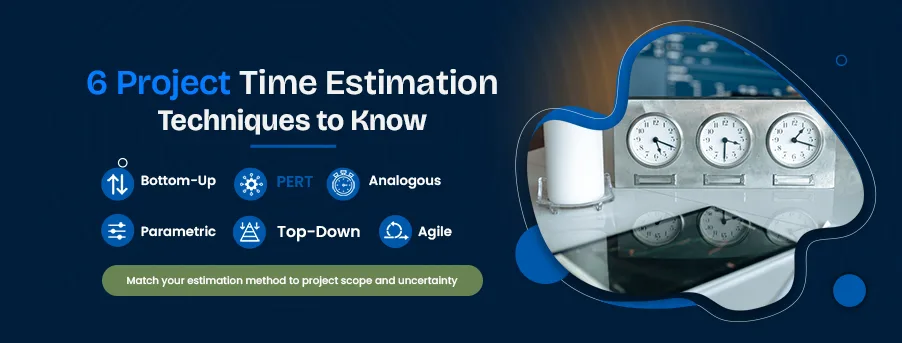
- The proven project time estimation techniques
- Mastering Float (Slack) in project schedule optimization
- The key differences between Free Float and Total Float
- Why Float Analysis protects the project timeline?
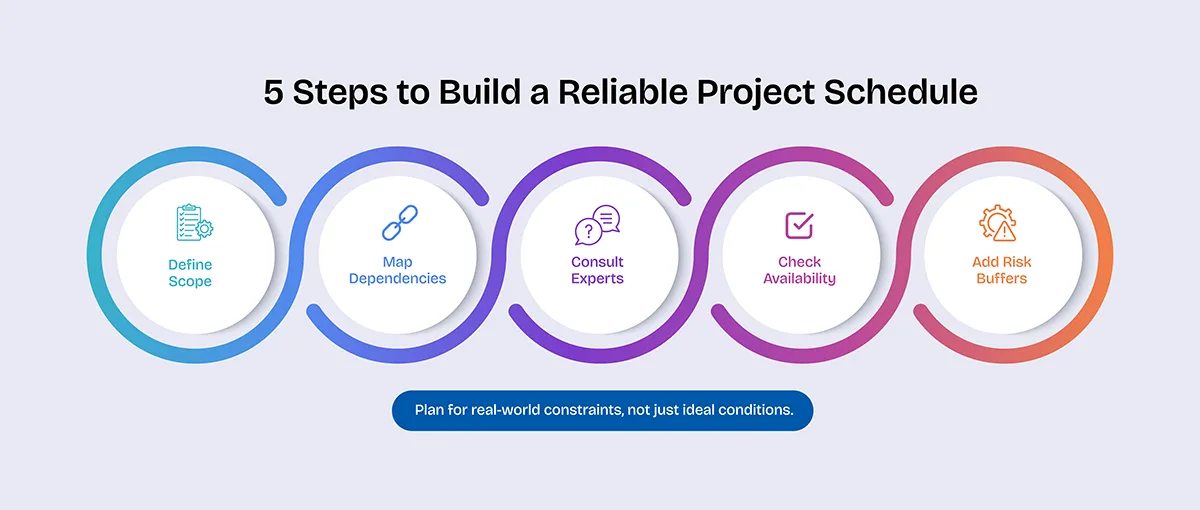
- 5 practical ways to build a bullet-proof project schedule
- Step 1 – Build a granular schedule after defining scope
- Step 2 – Map task dependencies explicitly
- Step 3 – Involve the execution specialists
- Step 4 – Account for the real resource availability
- Step 5 – Create explicit risk buffers at schedule level
- Top 3 modern trends that transform project time estimation
- AI-powered historical analytics and predictive estimation
- Automated resource capacity management
- Shift from output to outcome-based forecasting
- Pitfalls to avoid in project time estimation
- Bridging personal discipline with systemic Time Tracking
- Master your schedules with discipline and data
- Frequently Asked Questions (FAQs)
Think about this – you are kicking off a high-stakes project with an enthusiastic team, stakeholder buy-in and clear objectives – only to watch your carefully planned timelines crumbling in just a few weeks. A key developer falls sick, and the entire integration takes twice as long as promised, and client feedback rounds drag on endlessly.
Before you know it, your target launch date has vanished, team morale is plummeting and budget overruns are threatening the entire initiative.
If this scenario sounds painfully familiar, you are navigating the single most persistent challenge in modern enterprise operations – schedule variance.
Industry benchmarks continuously reveal a sobering reality – nearly half of all enterprise initiatives fail to hit their primary completion dates. Research across creative agencies, corporate IT and technical execution teams indicates that more than 45% of projects experience significant timeline slippage driven by:
- Uncalculated task dependencies
- Unrealistic calendar pressure
- Vague scope definitions
Getting the right project time estimation is not about offering optimistic promises to please executives or making perfect guesses. It is about empirical, structured frameworks which account for real-world complexity, operational buffer room and cognitive bias.
Whether you are managing multi-million-dollar software deployments or coordinating marketing launches, mastering time estimation in project management is your primary defense against project failure.
Why is time estimation so hard? The psychology behind planning failures
Before getting into schedule mechanics and estimation formulas, it is crucial for understanding why professionals routinely misjudge the time work takes.
Even the experienced project managers fall into predictable psychological traps which warp the timeline forecasts:
- Context switching penalty – Failing to account for the hidden friction of shifting between meetings, multiple applications and project tracks, which can drain up to 20% to 40% of an individual’s daily productivity capacity.
- Student syndrome – The tendency for delaying high-effort execution until the last possible moment before a deadline, eliminating any safety margin built into the schedule.
- Parkinson’s law – The principle which work expands to fill the time allotted for its completion. In case you assign four days to a task which requires four hours, it will mostly consume all four days for certain.
- The planning fallacy – Coined by psychologists Amos Tversky and Daniel Kahneman, this cognitive bias causes individuals to display optimal optimism when estimating future tasks, underestimating costs and risks while overestimating the benefits.
For building an accurate time estimation for project schedules, one must use techniques that are designed to counteract these human tendencies.
The proven project time estimation techniques
Different project scope levels and stages demand distinct techniques of time estimation. High performing teams blend top-down strategic estimates with granular bottom-up data for creating bulletproof schedules.
Bottom-up estimating (the gold standard of accuracy)
Bottom-up estimating is the most precise method that is available while a project scope is defined clearly. The technical leads and project managers break down the complete initiative into its smallest discrete components – work packages, by using a Work breakdown Structure.
- How it works – Each individual task is estimated by the specialist who will perform the work. Once the micro-estimates are gathered, they are rolled up into sub-deliverables, total project duration, and project phases.
- Best for – Mid-to-late planning stages where scope specs are finalized.
- Trade-off – Needs substantial upfront effort and time to compile but yields the lowest variance rate.
Reference class forecasting – overcoming the planning fallacy with empirical data
In place of depending on isolated guesses or mathematical equations, Reference Class Forecasting or RCF predicts the project timelines by looking at how similar tasks actually performed in the past.
Developed by Nobel Laureate Daniel Kahneman along with management theorist Bent Flyvbjerg, RCF removes human optimism bias by anchoring the schedule in historical reality.
How it works:
- Identifies Reference Class - Chooses a group of completed projects from past or tasks which share similar team structures, technical scopes and complexity.
- Analyzes historical outcomes - Reviews the true completion times for that reference class and notes how much longer the tasks took compared to their initial estimates.
- Risk adjustment - Adjusts the current timeline based on historical distribution of past performance instead of best-case expectations.
*** Ideal for** - High-stakes and complex project phases where unexpected external delays or human bias are likely to derail the static timeline projections. - Why it works - It eliminates the psychological trap of assuming 'this time will be different' by forcing the schedule to reflect proven organizational track records.
Analogous estimating (using historical benchmark data)
Analogous estimating uses the historical data from past completed projects of similar complexity, scale and domain to project the timeline of a new initiative.
- How it works - In case a past enterprise website migration took 10 weeks, and the new project has similar scope and architecture, 10 weeks serves as the baseline estimate.
- Ideally used for – Early project discovery phases when detailed specifications are unavailable.
- Risk – Highly dependent on real similarity. In case the new project includes different team seniority or unfamiliar tech stacks, the analogous estimates can significantly drift.
Parametric estimating (unit-based and algorithmic calculations)
Parametric estimating applies to statistical relationships between specific project variables and historical data.
- How it works – You determine the unit rates and measurable parameters. For example, if the historical data shows your team tests, writes and deploys clean documentation at a rate of 5 hours per technical module, a project needing 40 modules will yield an estimate of 40 x 5 = 200 hours.
- Ideal for – Standardized and repeatable tasks like physical hardware installation, content creation, data migration and infrastructure provisioning.
Top-down estimating (constraint and strategy-driven planning)
Top-down estimating begins with the overall target deadlines, which are often set by market launches, executive leadership or fixed contractual dates. It works backward to divide the total timeframe among project phases.
- How it functions – A 6-month product launch window is allocated top-down: 3 months for core building, 1 month for discovery, 1 month for deployment and 1 month for testing.
- Used ideally for – Initial high-level calendar mapping and feasibility analysis.
- Risk – Top-down estimates must always be validated against the bottom-up estimates for ensuring that the team capacity aligns with executive expectations.
Agile relative and velocity story point sizing
In the iterative product development, estimating the exact calendar hours early on often creates a false idea of precision. Agile framework teams replace the rigid hourly forecasts with relative sizing (example – Story Points using Fibonacci sequences 1,2,3,5,8,13)
- How it works – teams size tasks based on complexity, relative effort and risk instead of raw duration. Over the initial iteration, the team establishes its average number of story points completed per sprint or Velocity.
- Duration of forecasting – Total Backlog Points are divided by the Average Sprint Velocity, equal the total number of sprints needed to complete the project.
Mastering Float (Slack) in project schedule optimization
Calculating the durations of task is only half the battle in time estimation in project management. The true test of a project schedule lies in how the individual tasks interconnect.
This brings us all to the Critical Path Method or CPM and the concept of Float, also known as Slack.
Float represents the amount of time a project activity can be delayed without making a delay for subsequent tasks or the overall project completion date. Understanding the distinction between Free Float and Total Float is crucial for protecting your crucial path.

The key differences between Free Float and Total Float
Definition:
Free Float – The duration of time an activity can be delayed without delaying the early start date of any immediate successor task.
Total Float – The total duration of time an activity can be delayed from its early start date without delaying the final project finish date.
Why Float Analysis protects the project timeline?
- Preventing cascade delays – Monitoring the Free Float ensures that minor delays in non-critical tasks do not consume all available buffer room and unexpectedly create a new critical path.
- Resource reallocation – When a critical task runs late, project managers can divert resources away from the non-critical tasks which possess healthy Free Float without endangering intermediate milestones.
- Identifying critical path – Tasks with zero Total Float form Critical Path. If any task on the critical path slips by even one day, the total project completion date slips by a day.
5 practical ways to build a bullet-proof project schedule
For translating theory into execution, follow this step-by-step workflow while building the timeline of the project:
Step 1 – Build a granular schedule after defining scope
Never attempt for estimating timelines against vague project briefs. Deconstruct deliverables using a Work Breakdown Structure until work packages are broken down into manageable components.
Step 2 – Map task dependencies explicitly
Determine how the tasks relate to one another before assigning durations. Establish successor and predecessor relationships across the four-standard dependency types:
- Finish-to-Start (FS): Task B cannot start until Task A finishes.
- Start-to-Start (SS): Task B cannot start until Task A starts.
- Finish-to-Finish (FF): Task B cannot finish until Task A finishes.
- Start-to-Finish (SF): Task B cannot finish until Task A starts.
Step 3 – Involve the execution specialists
Avoid the common trap of project managers writing time estimates in isolation. Include the designer, software professionals, vendors or analysts who actually will be performing the work. Practitioners identify technical prerequisites, hidden complexities and operational steps which are often overlooked by the managers.
Step 4 – Account for the real resource availability
Never assume that a team member delivers 8 hours of dedicated project output per 8-hour workday. Real-world cognitive capacity is impacted by administrative duties, short rest periods, company meetings, and internal communications.
Step 5 – Create explicit risk buffers at schedule level
Instead of secretly padding estimates of individual task which trigger the Parkinson’s Law, keep the individual estimates tight and add a visible, centralized Project Contingency Buffer at the end of key milestones or critical path.
Top 3 modern trends that transform project time estimation
The landscape of project management is rapidly evolving. Modern operational framework and advanced technologies are changing how organizations monitor, forecast and optimize schedules.
AI-powered historical analytics and predictive estimation
Enterprise project platforms are rapidly integrating learning algorithms which analyze thousands of past completed code commits, project tickets and timesheet logs. By comparing the current descriptions of tasks with historical execution velocity, predictive AI engines highlight unrealistic estimates, suggest probability-based completion ranges and identify under-budgeted tasks even before the work begins.
Automated resource capacity management
Hybrid and remote work structures demand real-time visibility into the cross-functional resource allocation. Modern capacity management tools automatically cross-reference singular project assignments against PTO calendars, historical burn rates and multi-project workloads, preventing over-allocation and offering realistic availability forecasts.
Shift from output to outcome-based forecasting
Leading businesses are gradually moving away from measuring success purely by rigid adherence to arbitrary initial deadlines. Instead, the modern teams combine time tracking with value delivery metrics prioritizing scope flexibility, continuous delivery and progressive elaboration. Estimates are treated as dynamic baselines which are refined iteratively at every project phase instead of static commitments, carved in stone.
Pitfalls to avoid in project time estimation
Even seasoned project professionals make systematic errors during planning. Watch out for the following four schedule killers:
- Treating initial estimates as fixed guarantees
- Ignoring non-delivery overhead
- Confusing effort with duration
- Priceless padding
Bridging personal discipline with systemic Time Tracking
Applying the proven time-estimation techniques and structured schedule frameworks creates a solid personal foundation for project management. However, in modern corporate environments, individual planning often runs into a major structural hurdle: invisible operational leakages and disjointed workplace tools.
This is where the automated workforce visibility systems like TruTimer comes into the picture. Instead of forcing teams to manually record their work every minute, the software connects project capacity, time logs, and active task signals into a unified platform.
What TruTimer brings for modern teams:
- Seamless tool integration – The system works alongside the existing ecosystems like Redmine, GitHub, Azure DevOps and Jira, enabling service and development teams to monitor the time without breaking natural workflow.
- Privacy-focused design – Unlike the intrusive tracking software, TruTimer emphasizes trust more than surveillance by omitting keystroke logging and leaving features like randomized screenshots entirely in the control of company admins.
- Evidence-based client billing – For IT services, agencies and consultancies, tracked hours are tied to the active task context, offering clients verifiable and transparent work.
- Automated background tracking – TruTimer captures active work and identifies the idle periods automatically, removing the administrative pressure of end-of-the-day timesheet guesswork.
Master your schedules with discipline and data
Accurate project time estimation is the very bedrock of client trust, dependable project delivery and sustainable team workload. By stepping away from guesswork and adopting structured methodologies like rigorous float analysis, PERT risk-weighting and bottom-up decomposition, businesses can transform project schedules from hopeful guesses into predictable execution roadmaps.
Begin by auditing the recent project histories, involving technical experts in early estimation rounds, and creating schedules that account for real-world bottlenecks and human energy. When the timeline is controlled, the project outcome is also controlled.
Frequently Asked Questions (FAQs)
1. Can automated time tracking software improve accuracy of project estimation?
Yes, automated tools eliminate the errors of manual timesheet by capturing real-time active task signals and segregating productive work from idle time. Integrating background activity tracking into your time estimation in project management workflow provides historical baseline data, revealing true execution velocity and reducing future schedule variance.
2. Why do traditional manual project time estimates fail frequently?
Manual estimates depend on optimistic assumptions, static spreadsheets and subjective memory which ignore real-world work patterns. They fail to account for Parkinson’s Law or unaccounted administrative tasks. Modern project time estimation relies on real-activity tracking and historical variance metrics to ground delivery dates in dates into empirical data.
3. How does context switch affect time estimation for project execution?
Task switching and app-toggling create cognitive friction, by introducing hidden delays which degrade schedule accuracy. While executing time estimation in project management, managers have to account for non-delivery costs too, by applying a focus factor. This converts raw effort hours into uninterrupted and realistic calendar durations.
4. Which method is the best for time estimation in project management?
Bottom-up estimating offers maximum accuracy when scope details are clear, while the three-point estimating or PERT excels when managing high uncertainty. When establishing initial timelines for a time estimation for project initiative, project leaders often blend historical analogous data with bottom-up calculations for balancing planning speed with forecast precision.
5. What is the difference between free float and total float in project scheduling?
Total float measures how long an activity can slip without delaying the final project completion date. Free float tracks how long a task can delay without pushing back the early start date of any urgent successor task. Understanding both the metrics within project time estimation enables managers to safeguard critical path milestones.