
15 SMART Time Management Goals to Boost Workplace Productivity (With Examples)
Explore 15 SMART time management goals with practical examples to improve workplace productivity, manage priorities, reduce distractions, and meet deadlines.
Table of Contents (21 sections)
- What is SMART time management goal?
- The 5 pillars of workplace time management
- 15 SMART time management goals for employees
- Goal 1 – Implement the daily time blocking for core tasks
- Goal 2 – Mastering the Eisenhower Matrix for task sorting
- Goal 3 – Practice ‘Eat the Frog’ every morning
- Goal 4 – Reduce app toggling and context switching
- Goal 5 – Communication check-ins and batch eMail
- Goal 6 – use the Pomodoro technique for complex sprints
- Goal 7 – Audit and audit recurring meetings
- Goal 8 – Enforce mandatory agendas for all meeting invites
- Goal 9 - Establish no-meeting focus afternoon
- Goal 10 – Automate or delegate low-value administrative tasks
- Goal 11 – Standardize the frequently used work outputs with templates
- Goal 12 – Conduct weekly time audits for catching schedule leakage
- Goal 13 – Establish rigid digital shutdown boundaries
- Goal 14 – Align task types with personal ultradian rhythms
- Goal 15 – Take mandatory rest and movement breaks
- How can managers and employers support time management goals?
- Bridge personal discipline with systemic time tracking
- Frequently Asked Questions (FAQs)
It is 4.45 pm on a Wednesday. You have been sitting at your desk since 9.00 in the morning, constantly typing, moving, clicking and replying. Your eyes are tired; the calendar was packed solid all day. You take a look at the primary task list and realize the most important project on your desk has barely been touched.
So, where did the day go?
You are not alone in this frustration. Workplace research indicates that the knowledge workers spend 50% of their workday on ‘work about work’ where we chase approvals, switching between apps, navigating notification clutter and sitting through unproductive meetings.
Only a small fraction of the day moves in the line of high-value and deep projects that actually drive career advancement and business growth.
The solution is never working for longer hours or trying to squeeze more tasks into an existing bursting schedule. The solution is establishing actionable and structured time management goals.
When employees set clear objectives around how they protect, plan and execute their time, chaotic days transform into high-output and predictable routines.
This guide today breaks down the SMART framework for workplace productivity and provides 15-time management SMART goal example targets businesses can easily implement.
What is SMART time management goal?
Unclear resolutions like ‘I need to be more productive’ or ‘I will stop procrastinating’ fail most times because they lack a clear definition of accomplishment, accountability and structure.
To make goals actionable, businesses must follow SMART framework which denotes:
S for Specific – Defines with clarity what needs to be achieved by removing ambiguity.
M for Measurable – Includes percentages, timeframes or other metrics for tracking progress.
A for Achievable – Attainable and realistic based on the existing resources and workloads.
R for Relevant – Directly aligns with broader job responsibilities and professional growth.
T for Time-Bound – Has defined target deadline or recurring tracking interval.
Transforming a general intention into a time management smart goal turns a vague hope into an actionable operating system.
The 5 pillars of workplace time management
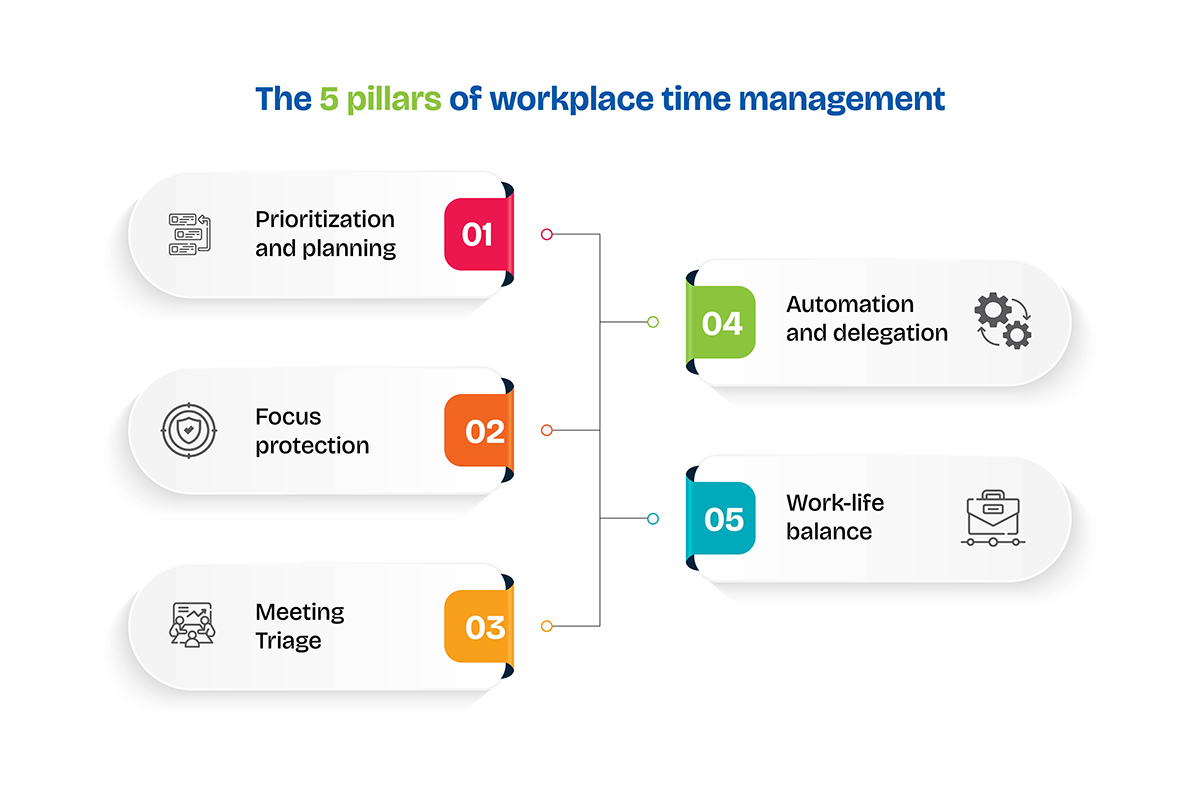
For creating a high-performing and balanced routine, time management goals must target the five core operational areas, that are:
In details:
Prioritization and planning – Organizing tasks by true strategic value instead of immediate urgency.
Focus protection – Guarding the cognitive energy against app switching penalties and digital interruptions.
Meeting triage – Reducing time spent in low-value synchronizations and unproductive discussions.
Automation and delegation – Using team members, tools and workflows for eliminating the manual busywork.
Work-life balance – Creating boundaries which preserve energy and prevent professional burnout.
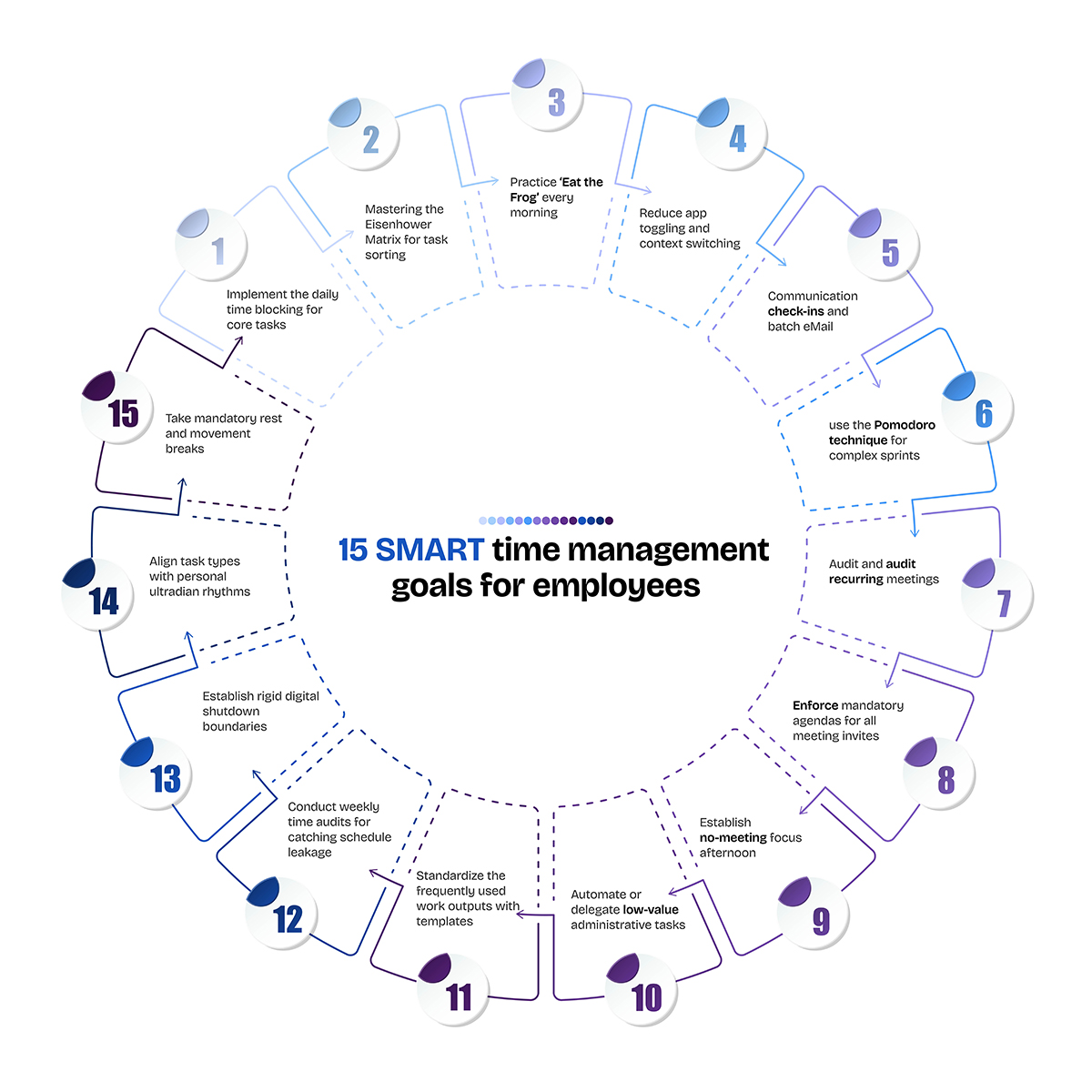
15 SMART time management goals for employees
Category 1 – Prioritization and daily planning goals
Goal 1 – Implement the daily time blocking for core tasks
Unstructured calendars leave your schedule open to everyone else’s priorities. Assigning the specific time blocks for your core deliverables ensures that critical tasks get your peak cognitive energy.
SMART goal – ‘For the next 30 days, I will spend 10 minutes at the end of every workday for time-blocking my top 3 priority tasks for the following day on my primary calendar, allocating at least 2 hours of dedicated execution time”
Why it works – Eliminates decision fatigue in the beginning of the day and converts an abstract to-do list into a concrete daily schedule.
Goal 2 – Mastering the Eisenhower Matrix for task sorting
When everything feels urgent, nothing gets correctly prioritized. The Eisenhower Matrix forces you to categorize work by importance and urgency.
SMART goal – “Over the next month I will categorize every incoming task using the Eisenhower Matrix during my morning planning, ensuring that at least 60% of my weekly working hours are spent on not urgent/important strategic project.
Why it works – Prevents daily fires from completely crowding out long-term strategic initiatives.
Goal 3 – Practice ‘Eat the Frog’ every morning
Tackling your most complex and hardest task first thing in the morning prevents procrastination and uses your fresh cognitive energy.
SMART goal – “For the next 6 weeks, I will complete my highest priority and most complex task within the first 90 minutes of my workday before opening my eMail inbox or team chat applications.”
Why it works – Builds quick momentum and frees up the mental bandwidth which would otherwise be drained by background anxiety.
Category 2 – Focus protection and distraction reduction goals
Goal 4 – Reduce app toggling and context switching
Research reflects that employees toggle between applications more than 1000 times a day, incurring a heavy ‘attention residue’ tax which drains mental stamina.
SMART goal – “Over the next quarter, I will reduce my daily app switching frequency by batching the administrative software tools into 2 designated 30-minute processing windows per day, reserving 4 continuous hours for single-task focus.”
Why it works – Preserves focus state and prevents focus fragmentation across multiple software platforms and browser tabs.
Goal 5 – Communication check-ins and batch eMail
Constantly checking eMail as notifications arrive disrupts deep work and keeps you in a perpetual state of reaction.
SMART goal – “Beginning next week, I will close my eMail client and team chat apps during deep work sessions, checking and processing communication in 3 dedicated 20-minutes windows each day. (10.00 am, 1.30 pm, and 4.30 pm).
Why it works – Transforms communication from a constant stream of interruption into an organized batch-processed workflow.
Goal 6 – use the Pomodoro technique for complex sprints
When faced with intimidating, large-scale, structured sprint cycles lower psychological friction and help you get started.
Smart goal – “For the next 4 weeks, I will execute a minimum of 4 Pomodoro cycles (25-minutes of focus followed by a 5-minute break) every afternoon for completing long-form writing and reporting tasks.”
Why it works – Gamifies focus and prevents mental fatigue through mandatory short rest intervals.
Category 3 – Audit goals and meeting triage
Goal 7 – Audit and audit recurring meetings
Unnecessary meetings are the single largest thief of productive time in the modern corporate environment.
SMART goals – “By the end of this month, I will review all the recurring meetings on my calendar, decline or eliminate low-yield sessions and convert at least 2 status update meetings into asynchronous written updates reclaiming 2 hours of weekly focus time.”
Why it works – Eliminates low-value status synchronizations which could easily be handled via text, doc comments or project boards.”
Goal 8 – Enforce mandatory agendas for all meeting invites
Attending unstructured meetings without clear objectives leads to rambling discussions and wasted hours.
SMART goal – “Starting immediately, I will decline or request clarification for any meeting invite which lacks a written agenda, target decision outcome, and pre-read materials at least 24 hours in advance.”
Why it works – Forces meeting organizers for clarifying objectives and ensures every session achieves concrete results quickly.
Goal 9 - Establish no-meeting focus afternoon
Creating multi-hour blocks where no meetings can be scheduled gives teams predictable windows for uninterrupted, deep execution.
SMART goal – “By the end of this week, I will coordinate with my team manager for blocking out every Thursday and Tuesday afternoon as a meeting-free focus block for the entire team.”
Why it works – Guarantees unbroken and large stretches of calendar time entirely dedicated for core project deliverables.
Category 4 – Automation, delegation and system goals
Goal 10 – Automate or delegate low-value administrative tasks
A major component of setting effective management goals is identifying tasks which should not be on your plate in the first place.
SMART goal – “Over the next 60 days, I will document 3 repetitive weekly administrative workflows, create standard operating procedures and delegate or automate them by using software for saving 3 hours per week.”
Why it works – Frees up high-value cognitive capacity by systematically offloading routine operational busywork.
Goal 11 – Standardize the frequently used work outputs with templates
Reinventing the wheel for proposals, routine reports and eMail wastes dozens of hours every month.
SMART goal – “Within the next 30 days, I will build 5 standardized eMail and document templates for our team’s most common client communications, reducing draft creation time by 40%.”
Why it works – Accelerates execution speed while maintaining consistent quality across recurring deliverables.
Goal 12 – Conduct weekly time audits for catching schedule leakage
Without regular reflection, old habits slowly creep back into your routine. A weekly audit keeps your operating system tight.
SMART goal – “For the next 8 weeks, I will spend 15 minutes every Friday at 4.00 pm reviewing my tracked hours against my planned goals, identifying time leaks and adjusting my calendar blocks for the following week.”
Why it works- Offers empirical data on where your time actually goes versus where you think it goes.
Category 5 – Work-life balance and energy management goals
Goal 13 – Establish rigid digital shutdown boundaries
Allowing work communications to spill into your evenings leads to chronic stress, sleep disruption and eventual burnout.
SMART goal – “For the next 30 days, I will complete a formal 10-minute digital shutdown routine at 5.30 pm, turn off work notification channels on my personal devices and refrain from sending eMails after hours.”
Why it works – Creates a clear psychological separation between personal life and work, allowing cognitive recovery overnight.
Goal 14 – Align task types with personal ultradian rhythms
Human energy naturally fluctuates throughout the day. Matching high-complexity tasks to your personal energy peaks dramatically boosts efficiency.
SMART goal – “Over the next 2 weeks, I will track my energy levels hourly to identify my peak focus window and reschedule 100% of my high-complexity creative work into that window while pushing routine admin work to my afternoon energy dip.”
Why it works – Maximizes output by aligning task difficulty with natural biological energy cycles instead of forcing focus during cognitive lulls.
Goal 15 – Take mandatory rest and movement breaks
Sitting continuously for 8 hours without breaks degrades the cognitive function, increases error rates and causes physical strain.
SMART goal – “For the next 4 weeks, I will take mandatory 5-to-10-minute physical movement break every 90 minutes during the workday, stepping away from all screens to recharge focus.”
Why it works – Reduces physical fatigue, resets mental stamina and maintains consistent focus quality throughout the afternoon.
How can managers and employers support time management goals?
Setting individual goals is half the battle won! Employees require organizational support and psychological safety for effectively executing their time management plans.
Managers can encourage better time usage across their teams by implementing three key structural practices:
Respect the focus boundaries – Honor employee calendar blocks. If an employee has blocked off time for Deep Work, avoid booking last-minute meetings or dropping ‘quick requests’ into their queue during those hours.
Protect asynchronous communications – Normalize non-instant response times. Teach teams that unless an issue is emergency, replies can wait until designated communication processing blocks.
Lead by example – Managers must model good habits. When leaders send eMails at 11.00 pm or host back-to-back unscheduled check-ins, employees feel pressured to adopt the same reactive burnout-inducing habits.
Bridge personal discipline with systemic time tracking
Setting individual SMART time management goals creates a strong framework for personal discipline, but today’s corporate environments often come with structural hurdles like disjointed workplace tools and invisible operational leakages.
Knowledge workers frequently waste precious focus toggling between communication apps, project management boards and manual timesheets.
Automated workforce visibility platforms like TruTimer bridge this gap by seamlessly connecting time logs, project capacity and active task signals into a single source of truth.
By quietly running in the background without intrusive keystroke logging, TruTimer captures evidence-backed data on the daily work patterns.
Such systematic visibility eliminates the administrative burden of day-to-day timesheet guesswork. Enabling employees and leadership to pinpoint actual task durations, protect the deep-work calendar blocks and turn individual productivity into measurable business growth.
Key capabilities of TruTimer at a glance:
- Smooth integration with the company ecosystem
- Evidence-based client billing
- Privacy-focused design
- Automated background tracking
- Turn time management goals into daily habits
Mastering your time is not about imposing restrictive or rigid rules on every minute of your life It is also about creating a flexible operating framework which protects your focus, reduces unnecessary stress and ensures your best cognitive energy goes toward the work that matters most.
Select two or more goals from the above list to address your daily leaks in productivity. Write them down by using SMART framework, track your weekly progress and adjust your routine as needed.
When you take control of your calendar, you can stop reacting to the noise of the workday and begin building a sustainable and high-impact career.

Frequently Asked Questions (FAQs)
What makes a time management goal SMART?
A SMART goal turns unclear intentions into an actionable system. It ensures your objective is Specific, Measurable, Achievable, Relevant and Time-bound. Setting structured time management goals helps employees protect deep-focus calendar blocks, reduce digital distraction and consistently meet critical project deadlines with minimal friction.
How can I measure progress on my time management SMART goals?
Track progress by pairing concrete metrics with weekly schedule audits. A practical time management SMART goal example involves logging actual task hours against initial baseline estimates. Monitoring focus time and project variance offers empirical data to refine future schedules and stop administrative work leaks.
How can automated software help in achieving time management goals?
Automated tools eliminate manual timesheet guesswork by recording active work and idle periods in real time. Integrating background tracking into your time management goals strategy gives employees clear visibility into actual task durations, highlighting operational leaks and validating execution velocity without invasive monitoring.
Why do traditional to-do lists fail without SMART time management goals?
Standard checklists list what needs doing but ignore the actual time of availability. Without setting a structured time management smart goal, tasks swell to fill open hours due to Parkinson’s Law. SMART goals map priorities to explicit calendar blocks, converting abstract lists into predictable, daily workflows.
How do time management goals prevent workplace burnout?
Establishing clear time management goals establishes firm operational boundaries around your schedule. By capping daily focus sprints, delegating routine busywork and setting strict digital shutdown times, employees protect their mental stamina and maintain their healthy energy levels, and sustain high-quality output without overworking.
What is a realistic time management SMART goal example for reducing interruptions?
A practical example is batching communication. Define a time management smart goal example like “for the next week, I will process mails only at 11.00 am”. This boundary will eliminate notification fatigue and protect long stretches for uninterrupted deep work.