
How to Create a Work Breakdown Structure for a Project: Steps & Examples
Learn how to create an effective Work Breakdown Structure (WBS) with seven practical steps. Explore key principles, WBS levels, real-world examples, and best practices to improve project planning, resource allocation, time estimation, and cost control.

Table of Contents (24 sections)
- Work Breakdown Structure – Definition
- The core work breakdown structure purpose in project management
- Eliminating scope ambiguity
- Driving accurate time and cost estimation
- Establishing accountability and clear ownership
- Protecting against uncontrolled scope creep
- The crucial rules and architecture of a WBS
- The golden standard – the 100% rule
- Understanding the 4 standard WBS levels
- The 8/80 rule for work packages
- Deliverable-oriented breakdown
- Phase-oriented breakdown
- How to create a breakdown structure
- Step 1 – Review scope of the project and supporting documents
- Step 2 – Identify high-level phases and deliverables
- Step 3 – Decomposition of deliverables into work packages
- Step 4 - Establish a standardized WBS coding scheme
- Step 5 – Build the WBS dictionary
- Step 6 – Map execution flow and task dependencies
- Step 7 – Review and validate against the 100% rule
- Connecting your WBS to real-time execution tool
- Building project planning with systemic time visibility
- For long-term success, build a better baseline
- Frequently Asked Questions (FAQs)
Imaging taking on a massive architectural build or multi-million-dollar software project. On the 1st day, the objective looks clear enough on paper. But as team members jump into execution, scope creep quietly sets in. Unmapped dependencies bring in sudden bottlenecks, and individual contributors lose sight of how their tasks fit into bigger picture and budget overruns begin to drain profit.
When the project plans fail, the root cause is rarely a lack of talent or effort. It is almost always a failure of scope decomposition.
Without a structured method to reconstruct high-level goals into clear, manageable components, even straightforward efforts can quickly descend into organizational chaos.
This is where work breakdown structure for project planning becomes indispensable.
A work breakdown structure acts as the foundation of modern project management. It transforms an intimidating, broad project charter into an organized tree of actionable deliverables.
Research across enterprise IT, product development and construction confirms that teams using structured WBS frameworks experience significantly lower scope variance and create more accurate project baselines.
This detailed guide today covers everything you need to know about building an effective WBS – its key design rules, core purpose, practical real-world examples a step-by-step creation blueprint and common pitfalls to avoid.
Work Breakdown Structure – Definition
As per the Project Management Institute or PMI, a work breakdown structure is a deliverable-oriented hierarchical decomposition of the total scope of work to be carried out by the project team for accomplishing the project objectives and building the required deliverables.
In simple terms, a WBS breaks a massive project down into more manageable, smaller pieces:
- Level 1 – Project goal
- Level 2 – Major phase or control account
- Level 3 – Work package
Crucially, a WBS is not a simple sequential to-do list, nor is it a project schedule. A schedule outlines when work will happen using calendars and timelines.
A WBS defines what the project encompasses by organizing all the tangible outputs into clear structural levels.
The core work breakdown structure purpose in project management
Understanding the primary work breakdown structure purpose is crucial for any project manager to create schedules that stand up to real-world execution pressures.
A WBS goes far beyond creating a visual diagram, it serves four key functions across the project lifecycles:
Eliminating scope ambiguity
The primary goal of a WBS is defining the exact boundaries of a project. By mapping the outcomes, stakeholders and project teams can quickly see what is included in the project – and just as crucially, what is excluded.
Driving accurate time and cost estimation
Estimating the effort or cost of a massive project all at once is a recipe for mistake. By decomposing the overall scope into granular work packages, subject matter experts can estimate labor hours, vendor fees, and material costs with greater precision. Rolling those lower-level figures back-up creates a dependable baseline.
Establishing accountability and clear ownership
Unclear task assignments often lead to missed deadlines. A well-designed WBS ensures every single work package has a defined owner who is directly accountable for its review, execution and final delivery.
Protecting against uncontrolled scope creep
Unplanned feature requests and dynamic client requirements are the major causes of project delays. A baseline WBS gives project managers an authoritative reference point. If a requested task does not map to a component in WBS, it is immediately flagged as an out-of-scope change request which requires formal evaluation, timeline adjustments and budget approval.

The crucial rules and architecture of a WBS
Before you begin building a structure, you need to understand the fundamental design principles and architectural levels which keep a WBS effective and clear.
The golden standard – the 100% rule
Coined by the Project Management Institute, 100% rule is the ultimate foundation of WBS construction.
- The structure must never include work which falls outside the defined scope.
- The sum of work at child levels must equal to 100% of the work represented by their parent level.
- The WBS must encompass 100% of the work defined by the project scope, including external, internal and project management deliverables.
Understanding the 4 standard WBS levels
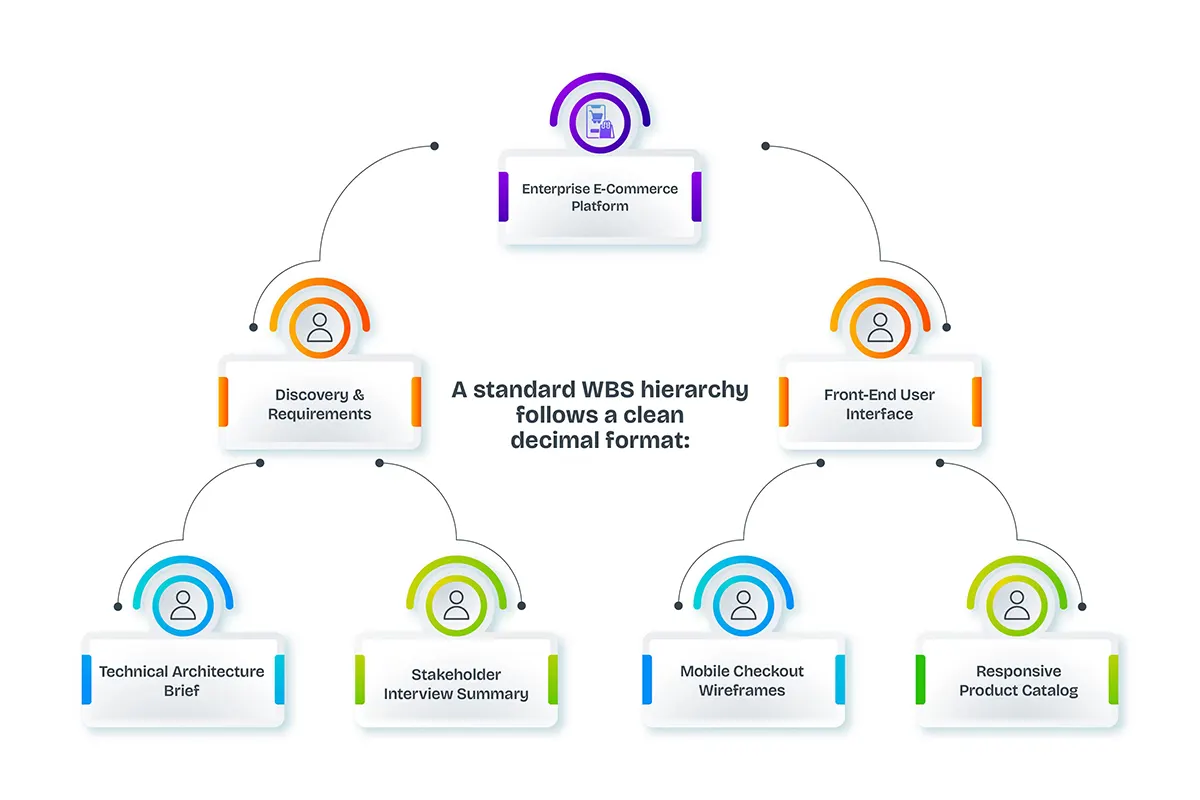
A typical WBS organizes project work into 4 hierarchical levels:
- Level 1 – Project goal / final deliverables – The ultimate objective or final product being created.
- Level 2 – Major deliverables / control accounts / phases – High-level functional areas, major sub-systems or project phases.
- Level 3 – Intermediate deliverables – Subcomponents which support and roll up into level 2 outcomes.
- Level 4 – Work packages – The lowest level of WBS. A work package represents a manageable and discrete unit of work which can easily be cost-estimated, scheduled, monitored and assigned to a single owner.

The 8/80 rule for work packages
How deep must you break down your work? The 8/80 rule provides a reliable benchmark. A work package should require no less than 8 hours of effort and no more than 80 hours of total effort. If a component takes longer than 80 hours, decompose it further.
Phase-oriented vs deliverable-oriented WBS
When you create work breakdown structure models, you must choose between two main structural approaches based on your project’s focus and methodology.
Deliverable-oriented breakdown
This approach structures Level 2 around functional or physical components of the final product.
- Ideal for – construction, hardware engineering, product manufacturing or software feature architecture.
- Example – Building a car broken down by chassis, engine, electronics and interior.
- Benefit – Keeps the team laser-focused on actual tangible outputs rather than background processes.
Phase-oriented breakdown
This approach structures level 2 around traditional project lifecycle stages.
- Ideal for – Business transformations, agile software development, consulting projects and creative campaigns.
- Example – Software rollout broken down by design, discovery, testing, build and deployment.
- Benefit – Clearly aligns with milestone-based schedules, stage-gate reviews and sequential team handoffs.
How to create a breakdown structure
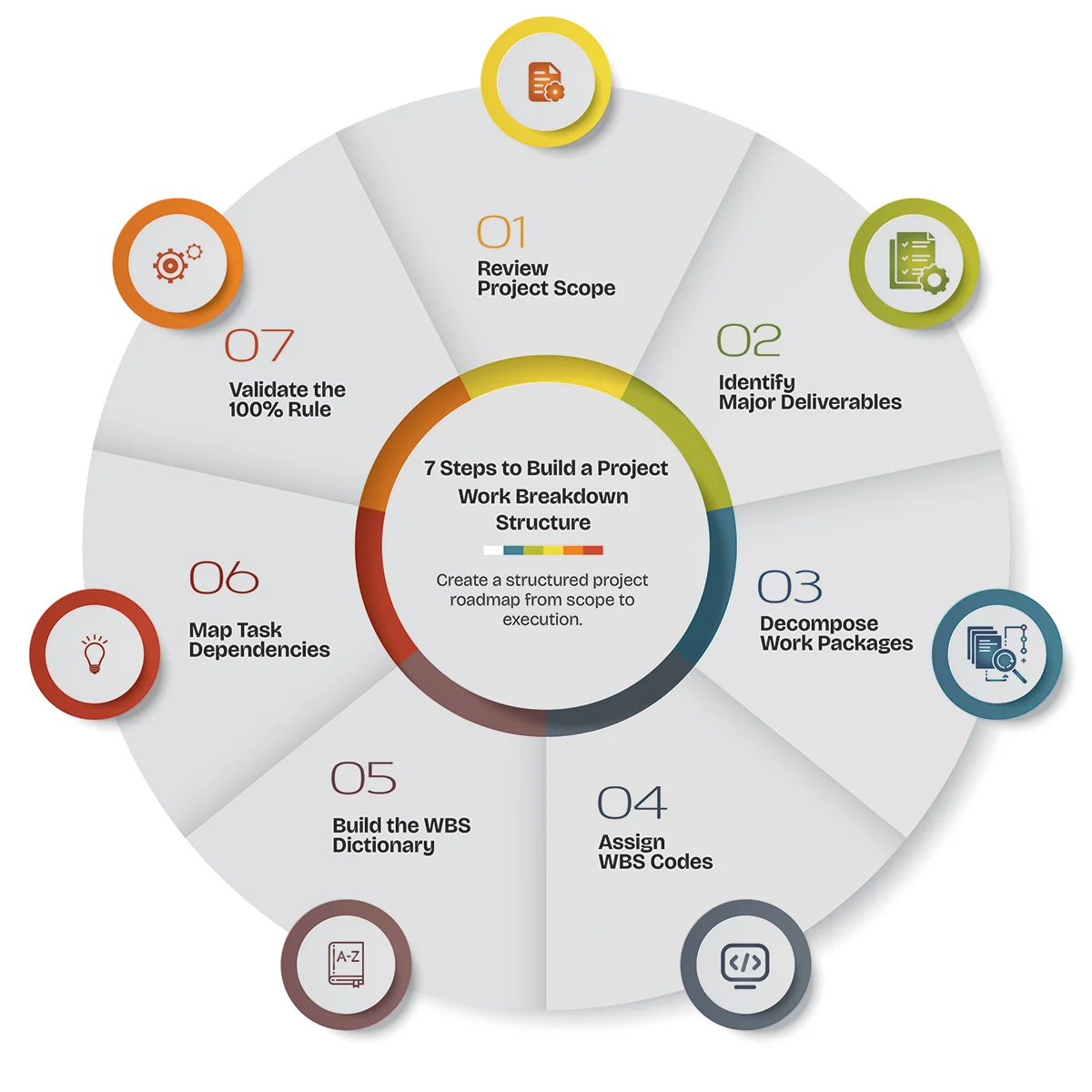
Building an accurate WBS needs a systematic approach, Follow the seven steps below to take your project from a broad scope document to a fully actionable execution plan.
Step 1 – Review scope of the project and supporting documents
Begin by collecting foundational project documentation – the statement of work, project charter, stakeholder requirements list and scope of statement. Ensure you clearly define the boundaries of the project, explicit exclusions, key milestones and final criteria of success. Engaging the key stakeholders at this step prevents critical omissions which could derail execution later on.
Step 2 – Identify high-level phases and deliverables
Determine how you will structure your top-level components. Work with domain experts as well as project leads to group the total project scope into primary phases or major deliverables. Ensure that these level 2 categories collectively account for the complete project outcome.
Step 3 – Decomposition of deliverables into work packages
Work through each Level 2 item and break down into smaller and more granular sub-components. Continue decomposing until you reach the work packages which comply with the 8/80 rule. Focus on defining tangible outputs by using noun-based descriptions (User Auth Module) instead of action-oriented task verbs (Coding User Auth), keeping your focus on what is being produced.
Step 4 - Establish a standardized WBS coding scheme
Assign a unique alphanumerical and numerical code to every element in your hierarchy. This coding system preserves the visual structure within database systems, cost accounting frameworks and project software.
Step 5 – Build the WBS dictionary
A WBS outline shows high-level relationships, but it does not provide all operational details the team requires daily. The detail lies in the WBS dictionary.
For every work package, create a small record that details:
- Acceptance criteria and quality standards
- Technical prerequisites and dependencies
- Estimated labor cost and hours
- Assigned resource/owner
- Statement of work description
- WBS element name and code
Step 6 – Map execution flow and task dependencies
Once the work packages are fully defined, identify relationships and prerequisites between them. Determine which components can be developed in parallel and which need predecessor approvals.
Mapping such dependencies will help you smoothly transition from your WBS to your project schedule and execution calendar.
Step 7 – Review and validate against the 100% rule
Review the complete structure alongside core technical leads, key stakeholders and project managers.
Ask the following important validation questions:
- Are there any items included in that fall outside the approved project scope?
- Does every work package have an assigned owner and measurable acceptance criteria?
- Is there any duplicate or redundant work mapped across numerous categories?
- Does adding up all the child elements equal 100% of the parent deliverable?
Connecting your WBS to real-time execution tool
While creating a text-based WBS is a great starting exercise, managing enterprise projects by using static documents which can quickly create operational silos.
Modern engineering, operations teams and product connect their WBS frameworks directly into project management platforms like GitHub, Azure DevOps Jira, etc.
Connecting your WBS to live execution platforms yields three major operational benefits:
- Automated resource balancing – Offers real-time visibility into workload distribution, ensuring team members assigned to specific work packages are not over allocated.
- Dynamic dependency management – Instantly updates downstream work package owners whenever upstream deliverables are delayed or completed early.
- Live variance tracking – Automatically compares your initial WBS labor hour estimates against real-time effort logs, highlighting potential budget overruns before they take place.
Building project planning with systemic time visibility
Creating a properly structured WBS gives your team a logical, clear blueprint for success. However, in the fast-paced workplace environments, individual planning often runs into the common operational barrier – invisible time leaks and disconnected tracking tools.
Team members often lose valuable focus switching between communication channels, project software, manual timesheets and repositories. When time tracking depends on scattered timers or manual memory, actual labor costs drift away from original WBS baseline estimates.
Automated workforce visibility solutions like TruTimer bridge this gap by connecting the task logs, project capacity and active signals into a single source of truth. By operating quietly in the background without intrusive keystroke logging, TruTimer captures evidence-backed clear data on real-world work patterns.
Such systematic visibility removes the daily friction of manual timesheets, giving project leaders the correct data they need to refine future WBS work package estimates, protect deep-focus blocks and turn the initial planning into predictable business outcomes.
Some notable capabilities of TruTimer
- Seamless ecosystem integration
- Evidence-backed client billing
- Privacy-focused design
- Automated background tracking

For long-term success, build a better baseline
Learning how to create work breakdown structure models is one of the most effective skills a project leader can build. By moving away from unstructured to-do lists and using scope decomposition, you can transform broad project plans into actionable execution roadmaps.
Start by gathering your team, defining your Level 2 categories and enforcing 100% Rule and pairing your structure with a complete WBS Dictionary. When you master the scope decomposition, you lay groundwork for accurate budgets, predictable delivery and long-term project success.
Frequently Asked Questions (FAQs)
Who should be involved in creating a Work Breakdown Structure?
The project manager must lead WBS creation alongside technical leads, client representatives, subject matter experts and key delivery team members. Involving the execution team early ensures accurate task estimates, uncovers hidden technical prerequisites and builds strong buy-in.
Why is the 100% Rule crucial while creating a WBS?
The 100% Rule ensures that your WBS captures the full scope of project, nothing more and nothing less. Adhering to this rule ensures that all lower-level elements sum directly to the parent scope, preventing unbudgeted tasks from slipping in or critical deliverables from being missed.
Can you use WBS in Agile project management?
Yes. In the Agile environments, a WBS maps high-level Epics at Level 2, breaks them down to Features at Level 3, and organizes individual User Stories into Work Packages at Level 4. This gives product teams clear scope boundaries while keeping execution sprints flexible.
Is a WBS deliverable-oriented or phase-oriented?
A WBS can be structured using either approach. A deliverable-oriented WBS categorizes components by tangible product outputs. A phase-oriented WBS groups elements by major lifecycle stages.
How detailed should a Work Breakdown Structure for a project be?
A WBS should be detailed enough to allow for accurate cost and time estimation, but not so granular that it becomes difficult to manage. Most project managers follow the 8/80 Rule, ensuring that the lowest-level work packages need between 8 and 80 hours of total effort.
What is the difference between a WBS and a Work Breakdown Structure Dictionary?
A Work Breakdown Structure is a hierarchical outline which displays a project’s total scope broken down by parent and child deliverables. A WBS Dictionary is a supporting document which provides detailed operational definitions for every work package, including resource needs, assigned owners and acceptance criteria.