
How to Measure Employee Performance: A Practical Guide
Learn how to measure employee performance effectively using key metrics, clear goals, productivity reports, and time-tracking software. Discover practical strategies to improve efficiency, evaluate work quality, and make data-driven decisions without micromanaging employees.
Table of Contents (36 sections)
- What Is Employee Performance Measurement?
- Why Is It Important to Measure Employee Performance?
- Identify Productivity Gaps
- Improve Employee Accountability
- Align Individual Goals with Business Objectives
- Recognize High Performers and Skill Gaps
- Improve Workload Distribution and Resource Planning
- How to Measure Employee Performance: 8 Key Steps
- Set Clear Goals and Performance Expectations
- Identify Relevant Employee Performance Metrics
- Measure Task Completion and Goal Achievement
- Evaluate Work Quality and Accuracy
- Monitor Time Usage and Work Efficiency
- Collect Feedback from Multiple Sources
- Review Performance Data Regularly
- Create an Action Plan for Improvement
- What Metrics Should You Use to Measure Employee Productivity?
- How to Create an Employee Productivity Report
- Essential Elements of an Employee Productivity Report
- Steps to Prepare the Report
- Best Practices for Measuring Employee Performance
- Focus on Outcomes, Not Just Hours Worked
- Use Role-Specific and Realistic KPIs
- Combine Quantitative Data with Qualitative Feedback
- Maintain Transparency About Performance Metrics
- Protect Employee Privacy and Use Monitoring Responsibly
- Recognize Improvement, Not Just High Performance
- How Time-Tracking Software Helps Track Employee Performance
- Common Mistakes to Avoid When Measuring Employee Performance
- Measuring Activity Instead of Results
- Relying on a Single Performance Metric
- Ignoring Work Quality and Employee Well-Being
- Comparing Employees in Different Roles
- Collecting Data Without Taking Action
- The Smart Way to Track Employee Performance
- FAQs
Tracking employee performance is long overdue for most organizations. Until now, businesses relied on legacy applications that failed to reflect the full picture. Employees who performed the best often remained ignored, whereas the workforce that needed help often remained unnoticed.
To tackle the situation with credible evidence, TruTimer has come to the rescue of organizations and employees alike. TruTimer gives managers an unambiguous way to track employee performance by connecting tracked hours, project work, and activity patterns in one system. Teams across various organizations now work on a mix of in-office, remote, and hybrid schedules, and that intermingling necessitates conclusive evidence.
Gallup reports that only about 2 in 10 employees strongly agree their performance is managed in a way that motivates them to do outstanding work, which suggests the real gap is in how companies measure productivity rather than in the work itself. Managers who track employee performance with clear goals, relevant metrics, and regular reviews give people a fair target and a reliable record of progress.
This guide explains how to measure employee productivity step by step, which metrics fit which roles, how to build an employee productivity report, and how time-tracking software like TruTimer supports the process. This guide provides a repeatable way to track employee performance without turning measurement into micromanagement.
What Is Employee Performance Measurement?
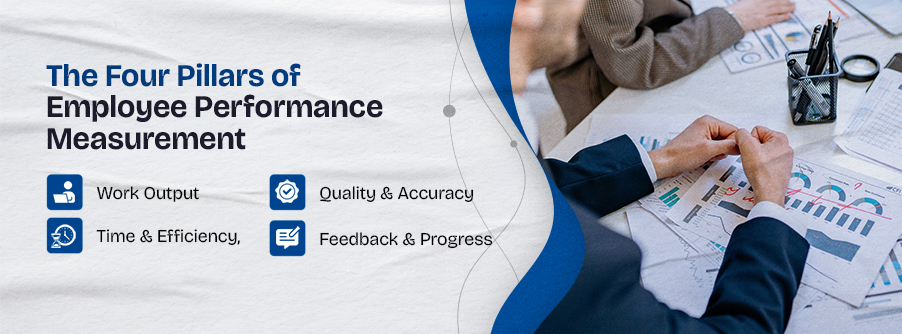
Employee performance measurement is the practice of comparing each person's work against set objectives, using data on output, quality, time, and feedback. It differs from performance management, which covers the full cycle of coaching, reviews, and development, because measurement supplies the evidence that every later step relies on.
Managers who track employee performance usually look at four things: what an employee delivered, how well the work was done, how long it took, and what colleagues or customers said about it. It’s the safest bet to measure employee productivity by both the quality and quantity of work completed. The number of tasks finished, or hours spent working, doesn’t offer a reliable overview.
In reality, businesses can expect a measurement system to work fine when employees are aware of the expected outcome in advance. The performance evaluation data sources from the real work instead of recollecting what is done by whom, and the results encourage constructive conversations rather than quick conclusions.
Why Is It Important to Measure Employee Performance?
Employee performance review replaces mere assumptions with strong evidence. Gallup research shows that employees who strongly agree their manager holds them accountable for their performance are 2.5 times more likely to be engaged in their job, so fair measurement supports morale as much as results. Verified records also help managers identify bottlenecks, improve processes, and support employee development while problems are at their infancy. A team that can track employee performance week after week spots trouble early, and a clear view of how to measure employee productivity keeps performance reviews focused on work quality, results, and progress.
Identify Productivity Gaps
Data shows where work slows down, whether the cause is unclear priorities, an overloaded teammate, or a handoff that keeps stalling. Asana's Anatomy of Work research reports that roughly 60% of the workday goes to coordination, such as status updates and meetings, instead of the work itself, so managers who track employee performance regularly can see how much of that load their own team carries.
Improve Employee Accountability
Defined goals give managers and employees a common basis for evaluating progress. Employees know what a successfully completed task looks like, and managers can track employee performance against those commitments.
Align Individual Goals with Business Objectives
Each employee’s goals should contribute to the team’s overall progress, such as faster delivery, fewer errors, or stronger client retention. For example, a developer's sprint commitments should connect to a release milestone.
Recognize High Performers and Skill Gaps
Efforts to track employee performance highlight who delivers consistently and who needs additional training, which keeps recognition unbiased and employee growth plans tailored.
Improve Workload Distribution and Resource Planning
Utilization and capacity data show who has room for more work and who is stretched thin. With that picture, managers who track employee performance can rebalance assignments before deadlines slip, and time underused by one team can help another team complete pending work.
How to Measure Employee Performance: 8 Key Steps
Knowing how to measure employee productivity follows a repeatable cycle that lets managers track employee performance against pre-defined goals. The eight steps below follow that order.
Set Clear Goals and Performance Expectations
Each role needs documented performance goals that state what success looks like, by when, and how it will be measured. Gallup finds that employees whose managers involve them in goal setting are more likely to be engaged, so invite people into the conversation. No manager can track employee performance reasonably without goals that both sides have accepted.
Identify Relevant Employee Performance Metrics
Choose a small set of metrics for each role, ideally three to five, and tie everyone to a goal from the first step, so each number helps track employee performance against something concrete. Task completion rate, on-time delivery rate, work quality, and customer satisfaction suit many roles. A long list of metrics dilutes focus and can lead to manipulation.
Measure Task Completion and Goal Achievement
Compare completed work with assigned work in each period. When teams manage tasks in Jira, Azure DevOps, or Redmine, much of the necessary data is already available. Using these records to track employee performance reduces duplicate data entry. The figures then flow straight into the employee productivity report.
Evaluate Work Quality and Accuracy
Quantity tells only half the story, so the fairest way to track employee performance is to check error rates, rework, defect counts, and client or peer review scores alongside volume. Those checks confirm that speed has not come at the expense of accuracy.
Monitor Time Usage and Work Efficiency
Time data shows how effort spreads across projects, tasks, and clients. Managers who ask how to monitor remote employees should rely on activity in context, such as active versus idle time and project mapping, rather than just keystroke logs. The same approach supports monitoring remote workers' productivity across time zones, because it examines work patterns instead of watching people constantly. Anyone analyzing how to measure employee productivity on a distributed team will find that accurate time records help managers track employee performance against effort as well as outcomes.
Collect Feedback from Multiple Sources
A well-rounded way to track employee performance draws on supervisor reviews, peer input, self-assessments, and client comments, because each source reveals elements the others miss. Combining them reduces the bias of a single viewpoint and gives employees a complete picture of how their work is assessed.
Review Performance Data Regularly
Monthly check-ins and quarterly reviews keep issues at the outset, whereas annual-only reviews limit the scope to bring change to the outcomes immediately. A consistent employee productivity report gives every review the same set of facts to follow up on.
Create an Action Plan for Improvement
Each review should end with clear next steps, the person responsible for each task, and a deadline. Possible next steps post-review include training, mentoring, workload adjustments, and updated goals. Managers who track employee performance and then act on the results see change, while those who only file the numbers remain stuck to the previous stage.
What Metrics Should You Use to Measure Employee Productivity?
Employee productivity metrics work best when they match the role, and managers who track employee performance by role get reliable results than those who use the same evaluation criteria for every employee. The table below lists the most common metrics and what each metric measures.
| Metric | What It Measures |
|---|---|
| Task completion rate | Number of assigned projects/tasks that reach the ‘done’ status within a certain timeline |
| Goal achievement rate | How far an employee/team has moved toward to achieve its goal |
| On-time delivery rate | Number of projects/tasks completed within the deadline |
| Work quality | How accurate the output is, based on the error count and the rework needed |
| Time per task | Hours/minutes spent completing a certain project/task |
| Billable utilization | How much time an employee/team has spent on client-billable work |
| Customer satisfaction | How satisfied clients are with the service quality and whether they will recommend others or not |
| Output per employee | How much work one has completed in a timeline, the resources used and the efforts it took to produce it |
The simplest answer to how to measure employee productivity is to pair one output metric, one quality metric, and one efficiency metric for each role. You can name it as the Balanced Trio Rule as a single number is never enough to define one’s performance quality. However, three deciding factors that cover output, quality, and efficiency give you confidence to make the right choice.
Developers, for instance, are best evaluated on delivery quality and project milestones, while customer support employees are better measured through resolution time, customer satisfaction, and first-contact resolution. Teams that bill clients by the hour add billable utilization, which compares billable hours with available working time.
However, do not make the mistake of considering each metric as be-all and end-all of the employee performance evaluation. Time per task suits repeat work but misleads on creative or complex assignments, where a slower pace can mean the employee might have carried out an in-depth analysis of the project in hand.
Managers who track employee performance with the right mix of benchmarks get a far more accurate picture than managers who rely on any one of them. Whichever metrics a team selects, they become the columns of the employee productivity report covered next.
How to Create an Employee Productivity Report
Reporting is the end of how to measure employee productivity, because it compares how well each employee has offered results based on the targets set for them. It's solid evidence that remains to both the employee and managers to set a thorough understanding of what the employee is assessed on.
Essential Elements of an Employee Productivity Report
A beneficial employee productivity report names the employee or team, the reporting period, the goals, the selected metrics, the targets, the actual results, and a short note explaining any variance. A brief section for next steps closes the loop.
Steps to Prepare the Report
First, pull data from the same sources every time, such as project trackers and tracked time. Second, compare each result with its target. Third, add context, including holidays, shifted priorities, or blocked work. Finally, share the report with the employee before the review, so the conversation between the employee/team and managers takes place based on real facts.
The illustrative example below shows how the format works.
| Metric | Target | Employee Outcome | Status |
|---|---|---|---|
| Task completion rate | 90% | 86% | Below target |
| On-time delivery rate | 95% | 92% | Below target |
| Rework rate | Under 5% | 4% | On target |
| Billable utilization | 75% | 78% | Above target |
| Customer satisfaction | 4.5/5 | 4.6/5 | Above target |
This employee exceeds expectations on utilization and satisfaction while falling slightly short on completion and deadlines, which points the manager toward workload or scoping rather than effort. When managers track employee performance with a monthly employee productivity report, identifying such patterns becomes easier. So, it lets managers help the team or employee improve where needed.
Best Practices for Measuring Employee Performance
Fair measurement is a core part of how to measure employee productivity responsibly, and it depends on consistency, context, and openness.
Focus on Outcomes, Not Just Hours Worked
Oftentimes managers nitpick the hours worked by an employee, but it in no way ensures premium work quality. While hours show availability, outcomes show value. A person can be online 24/7 and still produces subpar quality work. So, it’s advised teams to track employee performance by outcome rather than how long they’re present in the office or in front of the screen.
Use Role-Specific and Realistic KPIs
If a manager sticks to the same KPIs for each team, the outcome might not be up-to-standard. A person working in the content marketing team might work well when keyboard activities are measured, whereas the same benchmark might fall short when you’re analyzing the work of a SEO executive as they often perform deep analytical work that only evaluating keyboard activities fails to assess.
You can also relax knowing TruTimer only looks at keyboard and mouse activity levels, never what you type. So, there’s no risk of breaching employee privacy in an effort to track productivity.
Realistic KPIs make it possible to track employee performance without punishing people for factors outside their control. Managers should plan targets based on past results and current workload and keep adjusting them as priorities change.
Combine Quantitative Data with Qualitative Feedback
Sticking to verbal input without shedding light on numbers can make the review process confusing and dubious. Numbers show what happened, and feedback explains why it happened. Managers who track employee performance with a focus on both deal with fewer surprises while reviewing employee performance.
Maintain Transparency About Performance Metrics
Employee performance review without being clear about what is measured against what can turn the assessment ambiguous. The best way to keep employees updated about the evaluation program is to let them know which metrics apply, how the data is collected, and who can see it. It makes the process reliable to the team/employee.
Protect Employee Privacy and Use Monitoring Responsibly
New York, Connecticut, and Delaware require employers to give employees prior to written notice of electronic monitoring, and other state and federal rules may add obligations. So, employers should confirm current requirements of employee monitoring with legal counsel. Managers who want to know how to monitor remote employees responsibly should keep screenshots optional, limit data to what the goals require, and use activity data to guide performance discussions. The same discipline applies to monitoring remote workers' productivity across states and time zones.
Recognize Improvement, Not Just High Performance
Managers often get stuck on the idea that a sustained high rating is the only way to determine a high performer. But it isn’t quite simple. A steady climb from a low baseline often uncovers more effort and growth than a consistently high score. And progress deserves acknowledgment.
Excessive monitoring, unrealistic targets, and isolated metrics produce misleading assessments. Transparency, consistency, and constructive feedback keep every review credible.
How Time-Tracking Software Helps Track Employee Performance
Time-tracking software like TruTimer helps managers track employee performance by recording when work happens, tying hours to projects and tasks, and turning that data into reports. Manual timesheets rely on memory, and memory fills gaps with guesses. Harvard Business Review reports that the average knowledge worker switches between apps roughly 1,200 times a day, so every toggle is a chance for an hour to go untracked. Accurate records also carry legal weight, since the Fair Labor Standards Act requires employers to keep records of hours worked by nonexempt employees.
TruTimer is built around that need. The platform tracks work time automatically in the background, separates active work from idle gaps, and maps every tracked hour to a project, task, or ticket, whether native or from Jira, Redmine, Azure DevOps, GitHub, or GitLab. Timesheets build themselves from that activity, and offline tracking keeps field crews and travelers covered when connectivity drops. For performance analysis, reports on utilization, active versus idle time, and project drift show where hours leak and which projects are slipping while there is still time to act. A Resource Pool view adds org-wide spare capacity, so managers can see who is free across teams.
Privacy is also considered while developing the platform. Role-based access scopes employees, managers, admins, and clients to the data their jobs require; tenant data stays isolated, and screenshots remain optional and admin-controlled. Teams that want a credible answer to how to measure employee productivity across projects get time, task, and capacity data from one source of truth, which makes each employee productivity report easier to build and easier to trust.
Common Mistakes to Avoid When Measuring Employee Performance
Teams can easily misjudge employee productivity when the methods they use to assess performance are poorly designed. An evaluation metric chosen without context, a target set without input, or a review held not often enough can distort the picture, and decisions built on that picture drift further from reality with every cycle. Five mistakes appear most often across industries, team sizes, and reporting styles, and each one is easy to work on once a team learns to recognize it.
Measuring Activity Instead of Results
Clicks, keystrokes, and logged-in hours describe busyness, not accomplishment. Managers who track employee performance through activity alone miss what matters, which is whether delivered features, resolved tickets, or retained clients moved the business forward.
Relying on a Single Performance Metric
A performance analysis should never rely on just one single number. One number highlight only one aspect of the complete picture and keeps the rest hidden. A support agent who closes tickets quickly may leave customers unhappy, so accentuating only one side of the performance doesn’t do justice.
Ignoring Work Quality and Employee Well-Being
Paying no attention to employee welfare and expecting outstanding results is unattainable. While it might work in the short-term, it’s not sustainable in the long haul. Prioritizing output at the expense of quality leads to rework and burnout. Managers who track employee performance should watch overtime, error rates, and signs of workload strain alongside how well employees meet targets.
Comparing Employees in Different Roles
Managers who analyze employee performance based on the same goals instead of considering how different each role is will surely arrive at the wrong judgement. Example: a designer, developer, and an account manager create value in different ways, so each employee deserves a comparison against their own goals and role benchmarks.
Collecting Data Without Taking Action
Managers who track employee performance but never respond to the results teach employees to ignore the numbers. An employee productivity report that nobody discusses only adds overhead. Measurement should lead to meaningful feedback, better processes, and achievable improvement plans.
The Smart Way to Track Employee Performance
Effective employee performance measurement combines output, quality, efficiency, and feedback, and it rests on four habits: clear goals, relevant KPIs, regular reviews, and fair evaluation. Managers who track employee performance this way make decisions based on evidence instead of impressions, and the right reporting and time-tracking tools make those decisions faster and easier to defend. Knowing how to measure employee productivity also means knowing that a reliable employee productivity report shows employees exactly where they stand.
Ready to track employee performance with proof instead of guesswork? Schedule a TruTimer demo for a 2-minute walkthrough of time tracking, productivity insights, and employee productivity reporting on your own workflow.
FAQs
1. Which KPIs are best for measuring employee performance?
Managers might come across endless employee performance metrics that bring into focus different areas of employee goals. It underscores the way each team performs, and which metrics should be evaluated for which team. While it’s never a standardized approach, some employee performance metrics suit diverse situations better compared to others.
Let’s check out the metrics that most managers can take into consideration:
- How many tasks are completed in a day
- How accurate the job is
- Is the employee compliant with the job requirements to complete it?
- Customer Satisfaction Score (CSAT)
- How long does each task take to complete it?
- How many working hours can be billed to the client
- Volume of completed work
2. How does employee performance tracking benefit an organization?
While it might seem employee performance tracking is about keeping a keen eye on employee output, it also plays a vital role in defining the strength and weakness of every employee. Along with this, the performance analysis also helps shed light on how well the employee is also critical to meet the company’s pre-defined objectives.
So, let’s explore how it benefits an organization:
Keeps employees engaged and motivated: when employees’ contributions are given credit, they go above and beyond to reach the targets. Routine feedback from managers helps employees take a close look inside their performance and improve it as per the supervisor’s expectations.
Data-driven decisions: Regular employee performance analysis streamlines the decision-making process when the time to promote employees from the team comes. It also gives insights into who needs training or needs leadership pipeline planning. It eliminates the risk of favoritism or bias among team members.
Low risk of micromanagement: Work performance review reduces the risk of intrusive supervision where the manager controls employee movement and their independence to perform work. Performance assessment via time-tracking tools like TruTimer gives a better grasp of how much an employee has spent on which task and the outcome of the efforts to keep the relationship between managers and the team healthy.
Strategic alignment: Every organization has a goal that employees help to achieve. A performance analysis helps managers look at the details into how well each employee plays their role in assisting the organization to meet that goal. If someone is lagging behind, the review also supports them to improve and reach the position of attaining them.
Objectives and Key Results (OKRs) help organizations maintain transparency in their decision-making process. Everyone gains reliable insights into others’ performance and where they need improvement. It also improves employee satisfaction as they build a healthy relationship with failure and understand how to build greater resilience amidst the performance review.
3. How does employee performance tracking support employee engagement?
Employee performance tracking supports engagement by giving people clarity about what good work looks like and how their efforts are received. Gallup research shows that employees who strongly agree with their manager to hold them accountable for their performance are 2.5 times more likely to be engaged. Regular, specific feedback and recognition built on real data help employees feel seen, and that sense of progress keeps them invested in their work.
4. Is employee performance tracking ethical?
It can be, and a lot depends on how a company deals with performance tracking rituals. Ethical tracking is open about what it collects, sticks to what the goals require, and exists to help people do better work rather than catch them out. Employees deserve to know what data is gathered, why, and who sees it. Several states, including New York, Connecticut, and Delaware, also require written notice of electronic monitoring. Keeping screenshots optional goes a long way toward building trust.
5. When should a business invest in employee performance tracking software?
Usually when the old way of doing things starts to creak, businesses invest in employee performance tracking software like TruTimer. Maybe timesheets keep arriving late or half-finished; clients question billable hours, or a remote team across several time zones is hard to keep in sync. Many managers also notice that projects are overrun before anyone notices. As a team grows, spreadsheets prove unfit to connect goals, hours, and results, and that is a good opportunity to bring in dedicated software.
6. Which features matter most in employee performance tracking software?
The most useful features are automatic time tracking, task and project mapping, and idle detection that separates active work from gaps. Reports on utilization and project drift then turn that data into decisions. Integrations with tools such as Jira, Azure DevOps, and Redmine prevent double entry, while role-based access and optional, admin-controlled screenshots protect privacy. Offline tracking also helps field and travel teams.