
10 Effective Time Management Strategies for Work to Boost Productivity
Discover 10 effective time management strategies for work to prioritize tasks, minimize distractions, improve focus, and boost productivity. Learn how techniques like time blocking, the Pomodoro method, and automated time tracking help teams work smarter and achieve better results.
Table of Contents (15 sections)
- The fatal flaw in today’s time management
- 10 effective time management strategies at work
- The Eisenhower Matrix (Segregating urgency from importance)
- Task batching and time blocking (ending context switching)
- Pomodoro technique
- The Pareto principle
- Eat the frog
- Setting strict boundaries around digital noise
- Strategic delegation
- Follow the two-minute rule
- Ultradian rhythms and energy management
- The weekly review
- Bridge personal discipline with systemic time tracking
- Conclusion
- Frequently Asked Questions (FAQs)
What does a Wednesday look like in your work life? You sit down at 9 am, with a major task you intend to finish. Then suddenly, notifications begin to pop up on your screen, mentioning an urgent Teams message demanding a quick reply. Then an eMail pops up and a last-minute check-in status gets added into your morning calendar.
By 5.30 in the evening, you are immensely exhausted, with a scattered desk and strained-red eyes. But when you look back to that main task for the day, the realization hits – you have barely scratched the surface!
No, you are not suffering from a lack of willpower but navigating a workplace system that is designed for distraction.
The recent Anatomy of Work research by Asana reveals that the knowledge workers spend nearly 60% of their day on ‘work about work’ – chasing approvals, sifting through app clutter, sitting in unnecessary meetings and writing status updates.
Only a fraction of the day goes towards deep-focus projects that you were hired for delivering.
The fatal flaw in today’s time management
Before we jump into the strategies for effective time management, we have to address a common myth – time management is not about squeezing every spare minute into a productive output.
Humans are biological beings who operate on natural cycles of focus, energy and cognitive stamina. Trying to run at the maximum output for straight 8 hours is a quick path to poor decision-making, burnout and substandard work.
The core goal of implementation of effective time management tips is to manage cognitive energy alongside calendars.
When one matches the hardest task to highest energy hours, and creates automated systems for routine busy work, productivity stops feeling like a daily struggle!
Let’s have a look at the:
10 effective time management strategies at work
The Eisenhower Matrix (Segregating urgency from importance)
Former US President Dwight D. Eisenhower had famously observed that what is urgent is seldom important and what is crucial is seldom urgent.
His approach was later on formalized by Stephen Covey into a four-quadrant matrix which remains one of the top time management tips, followed by high-performing leaders today.
Here’s how you can follow the quadrant:
- Quadrant 1 – emergency client demands, revenue-impacting issues and critical deadline failure.
- Quadrant 2 – Deep analytical work, strategic planning, professional development and system improvements.
- Quadrant 3 – Non-essential check-ins, other colleague’s emergencies, usual status inquiries.
- Quadrant 4 – Chat scrolling, low-yield admin busywork and repetitive task re-checking.
Task batching and time blocking (ending context switching)
How much time do you waste by simply jumping between different applications?
A study by Harvard Business Review found that the average employees toggle between various apps as well as websites up to ~200+ times per day, which imposes a heavy mental fee known as context switching penalty.
Time blocking eliminates this by converting the to-do list into segmented time-slots on calendar.
Three ways to build a time-blocked calendar:
- Assign core work blocks by treating the deep focus blocks with same strict authority you would have given a meeting with your company’s team.
- Group like tasks or task batching by setting aside two dedicated 30-minute windows for clearing your inbox bulk.
- Leaving space for buffer zones instead of scheduling back-to-back tasks
Pomodoro technique
When faced with a complex and massive initiative like writing a 1000+word strategy document or creating thousands of lines of legacy codes, the hardest part will be the very start. Procrastination at work rarely begins from laziness, it comes up from task overwhelm and psychological friction.
The Pomodoro technique that is developed by Francesco Cirillo, breaks down intimidating tasks into structured and bite-sized sprints.
Here’s its 5-step execution cycle
- Choose a single task
- Set the first timer for 25 minutes
- Work with undivided attention until the timer rings
- Step away for a 5-minute break (non-negotiable)
- Complete four cycles in this way and then take a long and restorative break of 15 minutes to 30 minutes.
This rhythm keeps the brain functioning fresh with a sense of micro-momentum which makes starting way easier.
The Pareto principle
In the late 19th century, the Italian economist Vilfredo Pareto discovered that 80% of the land in Italy was owned by only 20% of the population. Over time, performance experts realized that this asymmetrical pattern applies to today’s enterprise performance too.
- 80% of the client impact stems from 20% of employee service offerings
- 80% of system crashes are caused by 20% of core underlying software bugs
- 80% of the business results come from 20% of daily efforts
To put this effective time management tip into practice, assess your daily activities and determine the top three or two responsibilities that generate the highest measurable outcomes for your department or role.
After isolating the high-value 20%, reorder your commitments to ensure these tasks receive your peak cognitive energy daily.
Eat the frog
"If it's your job to eat a frog, it's best to do it first thing in the morning. And if it's your job to eat two frogs, it's best to eat the biggest one first." – Mark Twain
In the context of modern work, frog is that uncomfortable and complex task that you keep pushing off for tomorrow. It can be drafting an uncomfortable client eMail, mapping out a critical project scope or beginning an intricate data analysis.
Here’s how you can practice to eat the frog:
- Determine the single biggest ‘frog’ the evening before
- Put the item right at the top of the schedule for next morning
- Addressing it before opening the inbox, checking messaging channels or getting pulled into team requests.
When you are done with the hardest task in your list, it generates a quick sense of accomplishment, setting a stronger tone for the day and freeing up the mental energy that would be consumed by a lingering anxiety
Setting strict boundaries around digital noise
Currently we live in an era where an average professional is demanded to be accessible constantly. Between project management boards, corporate chat applications, sudden video calls, eMail alerts and more, the employee attention is sliced into thousands of micro-fragments every day.
Research highlights which regaining deep focus after a single digital interruption takes an average of 23 minutes. When you multiply that by dozens of pings every shift, the entire day evaporates into reactive communication.
How you can reclaim your attention
- Teach your team that not everything needs an instant reply unless it’s a burning emergency.
- Disable the push alerts on your phone as well as desktop for anything which does not need quick intervention.
- Use calendar blocks as well as communication statuses for signaling when you are busy.
Strategic delegation
The Hero Complex is a common trap for ambitious professionals. This is the belief that if you want something done right, you have to do it yourself. This may work early in the career, but it quickly caps the growth and leads to professional burnout gradually.
Effective time management at scale needs proper recognition that time is a finite financial asset. If a task is able to be executed by a team member at lower hourly cost or with specialized skill sets, holding on to it can prove to be an operational bottleneck.
Best practices for delegation:
- Explain what success looks like instead of dictating how to get there.
- Ensure that the right person is taking up the task and he or she has the right tools, permissions, and context.
- Set-up asynchronous check-ins for reviewing progress instead of micromanaging every hour of execution.
Follow the two-minute rule
Popularized in Getting Things Done by productivity expert David Allen, the two-minute rule is a powerful antidote for small-scale procrastination.
This rule says – “If you see a task which takes less than two minutes for completion, like filing a document, replying to a quick scheduling request or approving an invoice, just do it right away.
You know why it works?
Accumulated micro-tasks heavily weigh your psychological bandwidth. Leaving dozens of small administrative duties for later can create a background hum of cognitive clutter. Managing them quickly prevents your to-do list from bloating with trivial items, keeping the mind as well as workspace clear for any next high-impact work.
Ultradian rhythms and energy management
Early, we established that time is fixed but the energy fluctuates. In case you try to force high-level strategic thinking during the natural afternoon slump, you will be able to accomplish in three hours what could be done in 45 minutes during the morning window.
Optimizing the daily energy curve:
- Take genuine short breaks by stepping away from screens to stretch, walk and hydrate to reset your cognitive stamina for the next focus sprint.
- Reserve your peak hours exclusively for Quadrant 2 complex problem-solving, strategic work or deep creation. Push routine eMails, administrative reviews and casual syncs into lower-energy afternoon valleys.
- Track your energy levels for one week. Note when you feel most creative and alert and when you feel sluggish.
The weekly review
The final strategy for building a bulletproof productivity system is regular reflection. Without a proper weekly review, even the best-designed daily schedule slowly drifts back into chaos. Taking 30 minutes at the end of every week for auditing your workflow ensures that the professionals stay aligned with long-term objectives.
The weekly audit checklist:
- Map your primary deliverable and ‘frogs’ for the upcoming days so that you hit the ground running on Monday.
- Where did the time go? Were there any kind of unexpected meeting or interruptions which derailed your time blocks?
- What kind of major deliverables did you successfully ship this week? Once you acknowledge this, your motivation will be fueled.
Bridge personal discipline with systemic time tracking
Applying these ten strategies mentioned above creates a powerful personal framework for time management. But in today’s corporate environment, individual discipline often turns into a major structural hurdle – invisible operational leakage and disjointed workplace tools.
Knowledge workers frequently toggle between communication apps, project boards, manual timesheets and repository systems. When time tracking depends on disconnected timers or manual memory, the hours can silently leak through administrative control, unverified estimates and untracked context switches.
Enter - TruTimer
Automated employee visibility systems like TruTimer connect project capacity, time logs and active tasks into a unified and single platform.
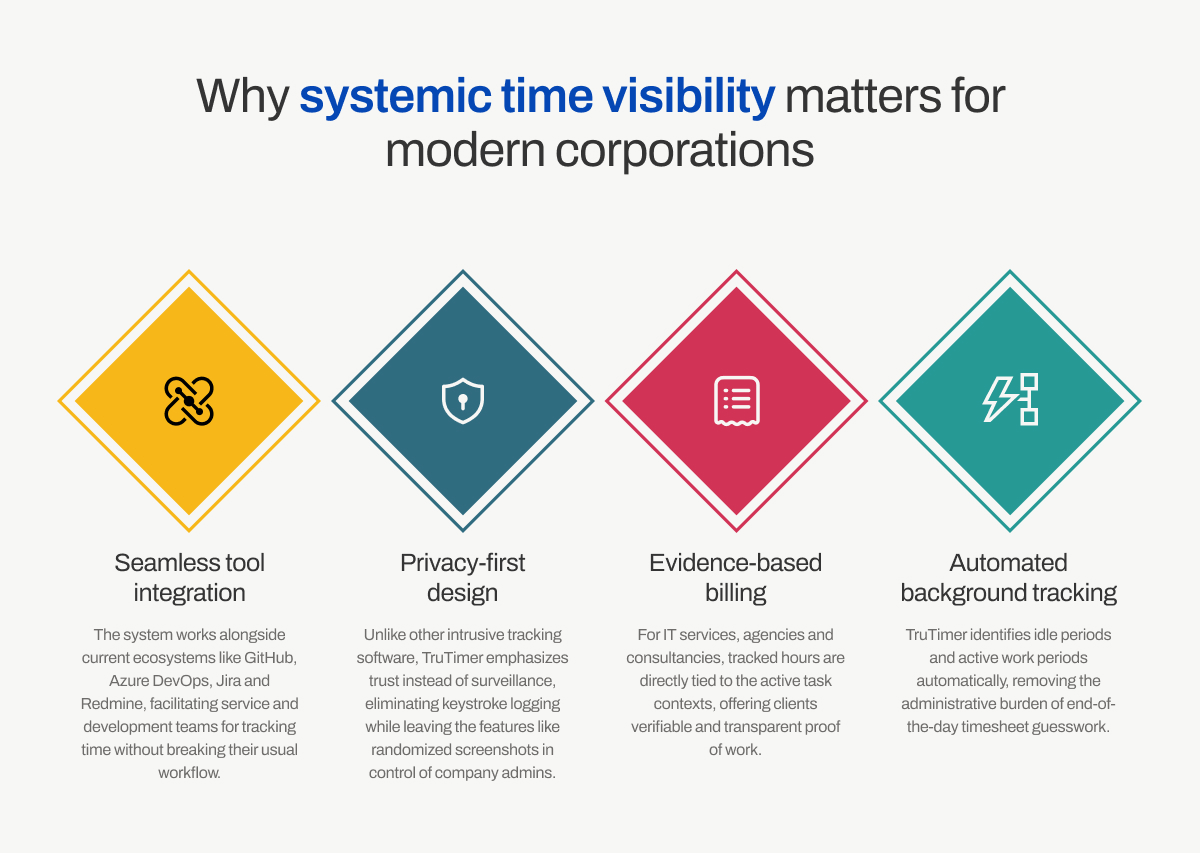
Why systemic time visibility matters for modern corporations
- Seamless tool integration
The system works alongside current ecosystems like GitHub, Azure DevOps, Jira and Redmine, facilitating service and development teams for tracking time without breaking their usual workflow.
- Privacy-first design
Unlike other intrusive tracking software, TruTimer emphasizes trust instead of surveillance, eliminating keystroke logging while leaving the features like randomized screenshots in control of company admins.
- Evidence-based billing
For IT services, agencies and consultancies, tracked hours are directly tied to the active task contexts, offering clients verifiable and transparent proof of work.
- Automated background tracking
TruTimer identifies idle periods and active work periods automatically, removing the administrative burden of end-of-the-day timesheet guesswork.
By implementing automated data in place of manual timesheets, organizations can protect employee focus, eliminate friction, and turn the daily productivity effort into measurable business growth.
Conclusion
Mastering time management strategies for work is a continuous process which aligns habits, systems, and energy. Avoiding reactive habits lets you protect the deep-work focus, reclaim your calendar, and eliminate daily overwhelm. By segregating true importance from urgency and using a modern automated time tool like TruTimer, you can transform the way your employees work by eliminating manual guesswork.
The goal is not just checking off the to-do list but creating space for high-impact output while protecting your mental well-being. Begin with two or three strategies today, take control of your time, career trajectory and productivity.
Frequently Asked Questions (FAQs)
How can I enhance my time management skills for work while dealing with constant interruptions?
We all have been there. Dealing with the stress of submitting a project within a deadline while constant noise around us from emails and team notifications interrupt our focus. The best way to put a stop to this chaotic environment is scheduling a time in your work day that’s targeted to getting done most of the important work.
Turn off all the non-essential notifications during this slot of intense work. Check your emails right before this slot and after it. You can also use indicators like Focus Mode in team chat apps to let others know to reach out to you later on.
Establishing clear team agreements around asynchronous communication ensures that the urgent issues get attention while protecting the cognitive space for complex, deep work.
How can hybrid and remote teams monitor time usage without creating a culture of micromanagement?
Remote teams maintain trust by concentrating on the verifiable output, and objective project metrics instead of close surveillance. Implementing privacy-first and transparent tracking platforms provides managers with clear workload and capacity insights without penalizing natural rhythms of work and logging keystrokes. When the team members understand that tracking validates their output and safeguards them, time visibility strengthens autonomy instead of destroying morale.
How does the Pareto Principle boost workplace output?
The 80/20 Rule, also known as the Pareto Principle, states that nearly 80% of the business results are generated from 20% of core activities. In time management, this needs auditing the weekly workload for identifying the top drivers of client value or KPIs. By focusing your cognitive energy on such critical high-impact tasks, while streamlining the routine admin duties, one can significantly increase the professional output.
Why do the traditional timesheets fail in capturing accurate billable work hours?
Manual timesheets heavily depend on end-of-day memory as well as subjective estimations, which lead to significant errors in reporting and uncaptured hours. Knowledge workers frequently misestimate time spent switching between different apps and underreporting small administrative tasks. Automated tracking tools like TruTimer eliminate this guesswork by recording active task engagement in real-time by providing verifiable and transparent data on active hours, separated from the idle periods, thereby facilitating accurate client billing.
How is time blocking different from the standard task-based to-do list?
Standard to-do lists define what needs to be done, ignoring the finite constraints of available hours and often causing overcommitment. Time blocking assigns specific time windows on your calendar for defined task categories. This transforms an abstract checklist into a practical path of daily execution, reducing mental fatigue from deciding what to tackle next and minimizing frequent app-switching penalties.
What are the top time management tips for effectively prioritizing daily tasks?
The most effective way for prioritizing daily tasks is by applying the Eisenhower Matrix with ‘Eat the Frog’ principle. Categorize your workload by importance and urgency and then isolate the Quadrant 2 strategic goals. Manage your single most high-impact and challenging assignment first before you check messages for the day to build the momentum and stop the high-yield responsibilities from being pushed aside.