
Is employee monitoring legal in India? The DPDP Act in plain English
Understand whether employee monitoring is legal in India under the DPDP Act 2023. Explore employer responsibilities, employee consent requirements, privacy risks, penalties, and key compliance steps ahead of the May 2027 deadline.
Table of Contents (8 sections)
- Phased implementation and statutory basis timeline
- Can we monitor employees without their consent?
- Does the clause in the offer letter count as consent?
- Statutory penalty structure
- What should we change before May 2027?
- The compliance checklist for organizations
- Which monitoring practices carry the most risk?
- Frequently asked questions
As hybrid and remote work models have emerged as the new standard, workforce management technology too has evolved beyond the usual time-tracking into continuous activity recording.
For the corporate entities in India, deployment of employee monitoring software has to comply with the provisions of the Digital Personal Data Protection Act, 2023, or the DPDP Act and the Digital Personal Data Protection Rules, 2025.
Employee monitoring is entirely legal under Indian jurisprudence but, is now strictly regulated. The employers must:
- Offer clear standalone notices
- Operate within explicit legal bases
- Establish a well-defined data retention limit
The short answer:
Employee monitoring is legal in India. The DPDP Act doesn't ban it but regulates it: what you collect, what you tell people, whether your consent is valid, and how long you keep the data. Full employer compliance is due by 13 May 2027.
Key takeaways
- Legal status – Monitoring is permitted but regulated with statutory conditions covering proportionality, transparency and purpose limitation.
- High-risk practices – Continuous keystroke logging, off-duty location tracking and unannounced webcam activation presenting non-compliance risks due to lacking proportionality.
- Penalty exposure – Consent non-compliance and monitoring fall under residual penalty tier, which is capped at 50 crores, whereas failures like data breach carry the maximum penalties of 250 crore.
- Invalid consent structures – Standard clauses embedded within the offer letter or employee contracts fail to meet the ‘specific, free, unconditional, informed and unambiguous’ standard mandated under section 6 of the Act.
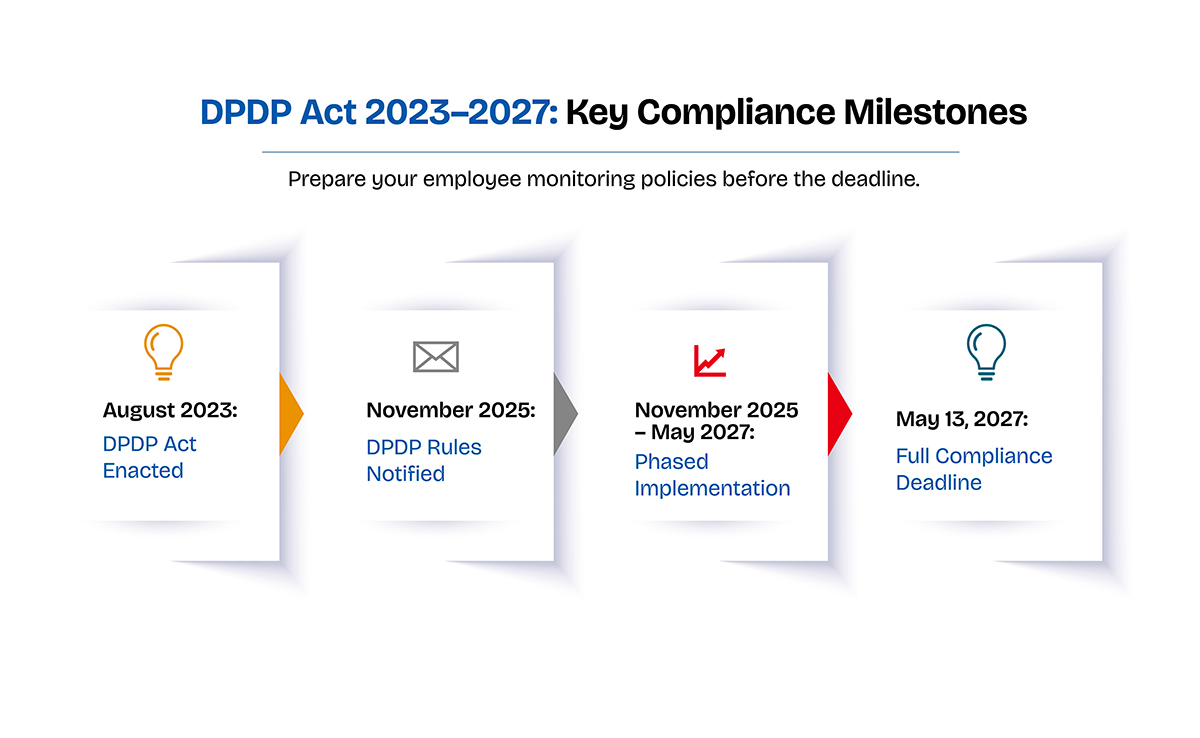
- Compliance timeline – Enacted back in August 2023, the framework had fully become enforceable following the Gazette notification G.S.R 846(E) on 13th November 2025. The 18-month phased implementation window is supposed to conclude on 13th May 2027, by which date full employer compliance is mandatory.
Phased implementation and statutory basis timeline
The DPDP Act governs the processing of digital personal data within India. Data captured by workplace productivity systems, including application telemetry, logged activity hours, geographical tracking and periodic screen captures qualifies as digital personal data under the law.
Following the formal publication of the Digital Personal Data Protection Rules 2025, under G.S.R 846(E), MeitY established an 18-month compliance runway.
| Date | What happens Regulatory and milestone requirement | Statutory Reference |
|---|---|---|
| August 2023 | Enactment of the DPDP Act, 2023 upon presidential assent. | DPDP Act, 2023 |
| 13 Nov 2025 | Notification of the DPDP Rules, 2025 (G.S.R 846(E)) establishing the Data Protection Board of India (DPBI) | Gazette G.S.R 846(E) |
| Nov 2025 → May 2027 | Implementation of Consent Manager registration frameworks and regulatory standards. | Rule 4 and Schedule I |
| 13 May 2027 | Enforceability of full corporate mandates (rights management, notices, data retention limits, breach protocols) | Rules 3,5 – 6, 22-23 |
If you employ people in India and process their personal data digitally, this timeline is yours. There is no small-company carve-out for the core obligations.
Note – While regulatory proposals in early 2026 discussed compressing of timeframe implementation to 12 months, the official Gazette deadline for the complete enterprise enforcement remains 13th May 2027.
Can we monitor employees without their consent?
Partly - and this is where most confident opinions in either direction fall apart.
The Act's Section 7 lists "certain legitimate uses" where separate consent is not required, and processing for the purposes of employment is one of them. Attendance, payroll, granting system access - the routine machinery of employing someone has a legal basis without a consent pop-up.
The open question is how far "purposes of employment" stretches. Legal commentary converges on a proportionality reading: routine, disclosed, work-related processing likely fits; intrusive surveillance - keystroke capture, always-on webcams, tracking beyond working hours - likely does not (CPO Magazine, 2025). For anything past the routine, you are back to consent. And that is where the trouble starts.
Does the clause in the offer letter count as consent?
This is the question that should worry you, because the standard Indian setup fails it on paper.
Section 6 requires consent to be free, specific, informed, unconditional and unambiguous. Now picture how monitoring consent is actually collected. It's someone's first day. Document nine of fourteen in the onboarding stack authorises "monitoring of company systems". Their job depends on signing the stack. They sign. Nobody explains what is collected, and there is no box to decline.
Was that consent free? Was it specific? Commentary published since the Rules argues no - some of it goes further and argues such clauses are void, not merely risky (LiveLaw, 2025). The Act also requires that withdrawing consent be as easy as giving it - hard to square with a clause that cannot be declined without declining the job.
Now run the same first day differently. The monitoring notice is its own document, in plain language: here is what we collect, here is why, here is what we never collect, here is who sees it. The employee can actually ask questions about it. Nothing about this is expensive. It is mostly a decision to say clearly what you are doing - which is easiest when what you are doing is defensible.
Under section 7(i) of the Act, personal data may be processed without explicit consent for “certain legitimate uses”, specifically for employment purposes or protection of employer from liability or loss.
Statutory penalty structure
Fines levied under Section 33 are capped based on non-compliance categories instead of imposed as flat statutory penalties:
Most coverage quotes "₹250 crore" and stops. The schedule under Section 33 is tiered, and the tier matters:
DPDP Act Penalty Tier Ceilings
| Category of Violation | Max Fine Cap (in ₹) |
|---|---|
| General breach (Unlawful monitoring / inadequate consent) | 50 crores |
| Violation of obligations regarding children’s data | 150 crores |
| Failing to notify users/board of a personal data breach | 200 crores |
| Failing to implement reasonable security safeguards | 250 crores |
Two things to hold onto. These are ceilings, not expected fines - the Data Protection Board sets the actual figure using the factors in Section 33(2), such as gravity, duration and repetition (DPDPA.com · King Stubb & Kasiva). And a monitoring-consent failure lands in the ₹50 crore tier, not the headline one. Quote the wrong tier in your board deck and the first lawyer in the room will discount everything else you said.
What should we change before May 2027?
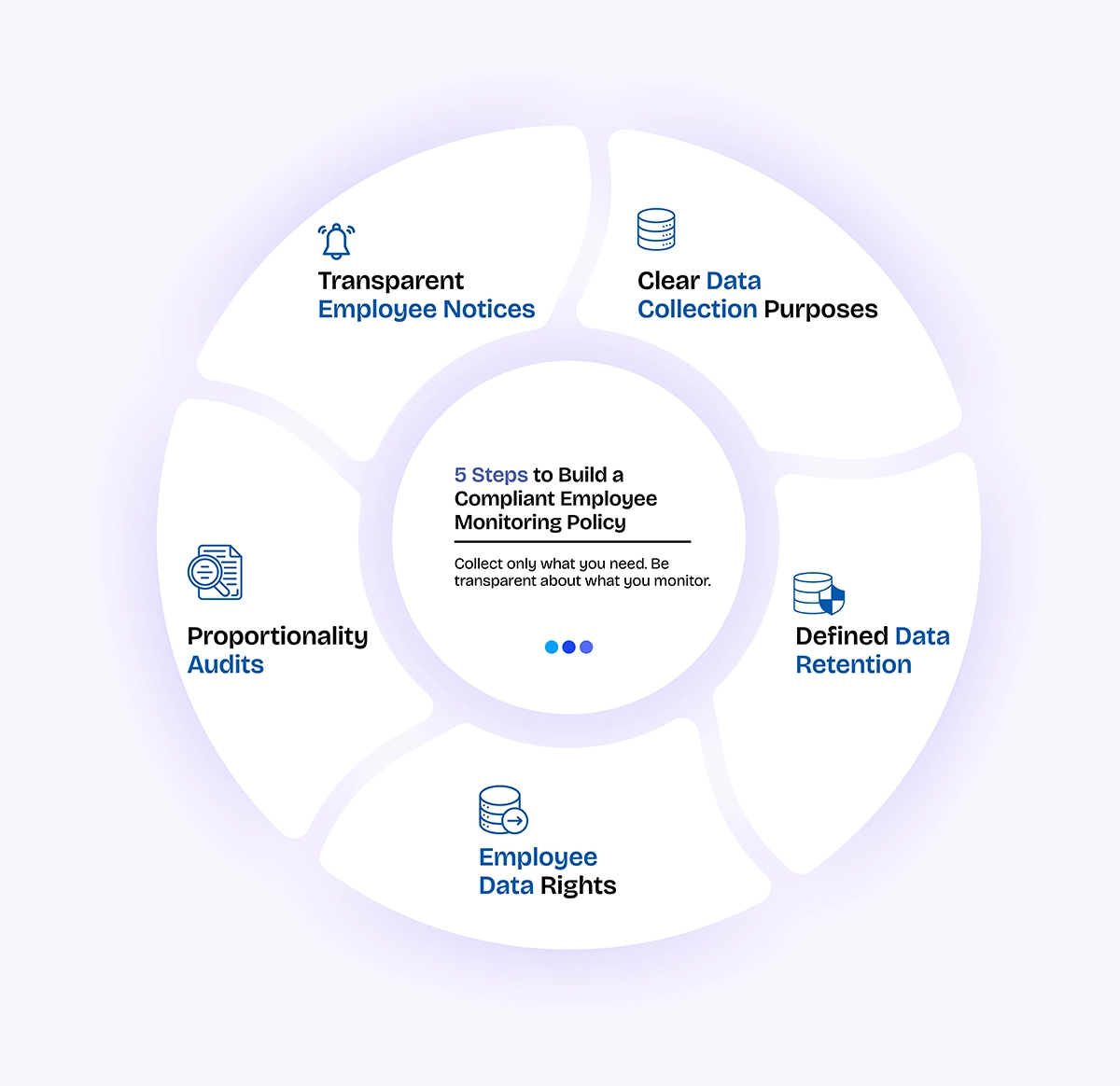
You do not need a legal team to start. You need to be able to answer five questions in writing:
- What do we collect? List every capture type your tools produce - time, screenshots, app usage, location, input activity. If you can't list it, the tool is deciding your policy for you.
- Why do we collect each one? Purpose, per capture type. "Because the tool has the feature" is the answer that fails proportionality.
- What did we tell people, and when? A notice someone can actually read - separate from the offer letter - beats a clause nobody remembers signing.
- Can someone see their own data, and can they withdraw consent? The Act gives employees the right to access, correction and erasure, and withdrawal must be as easy as consent.
- How long do we keep it? Screenshots from 2022 are not an asset. They are stored risk. Set a retention period and enforce it.
The compliance checklist for organizations
For achieving full compliance before 13th May 2027 deadline, organizations must implement a structured five-stage data governance audit:
- Enforceable retention protocols – Implement automated deletion policies so that the logs, screen captures, tracking data, etc are purged after the declared operational utility expires.
- Decoupled notice implementation – Draft plain-language, standalone notices carrying details of the specific data collected, employee rights and processing purposes.
- Data principal rights mechanisms – Create operational procedures which enable employees for requesting demand corrections, data summaries or formally submit the grievances.
- Proportionality audit – Confirm a valid legal basis for each metric. Remove invasive data capture settings which do not serve a specific security or business purpose.
- Inventory collection – Map all the data inputs collected by deployed productivity tools, including activity logs, desktop metrics, network metadata and screen recordings.
Which monitoring practices carry the most risk?
The commentary keeps naming the same three: keystroke logging, always-on webcam or screen capture, and continuous location tracking, especially outside working hours. They share one trait - the data collected wildly exceeds any stated employment purpose. That is the definition of disproportionate.
This is also where your choice of tool quietly becomes a legal posture. A tool that can't capture keystrokes is a shorter conversation than a tool where you promise the feature is switched off.
For transparency: this blog is written by the team behind TruTimer, and we built for that shorter conversation. The desktop tracker records that someone typed - activity counts - never what they typed; there is no keystroke logging to switch off. Screenshots are optional and admin-controlled, with retention you configure. Live location, used for field teams, is off by default and shows the person an active-tracking banner whenever it runs. Every capture type is a separate switch, so what you disclose in your notice can exactly match what the tool does. What none of this does is make you DPDPA-ready by itself - the law regulates your policy, notice and consent, not your vendor. A tool can only make the honest version easier to run. Where a full-surveillance product genuinely fits a need - some regulated call-floor environments require screen review - we are not that product, and you should evaluate accordingly. Pricing is public, in INR.
The certainty you are buying with all of this work is simple. The next time a candidate asks in an interview, "do you monitor employees?" - and in 2026 they ask - you answer in one sentence, without flinching: "Yes: tracked time and optional screenshots, disclosed on day one, and you can see everything we hold about you." Watch what that does to the room, because the companies that can't say that sentence are the ones this law was written for.
Frequently asked questions
Is it legal to take screenshots of employees' laptops in India?
Yes, with conditions: a clear, specific notice before capture starts, a valid legal basis (real consent or a defensible employment purpose), collection limited to work context, and a stated retention period. Undisclosed screenshotting, or capture bundled silently into an offer letter, is where the legal risk concentrates.
Can an employee refuse or withdraw consent to monitoring?
Yes. Where processing rests on consent, the DPDP Act requires withdrawal to be as easy as giving consent. An arrangement where refusing means losing the job undermines the claim that consent was ever free - which is the core argument against offer-letter monitoring clauses.
Does the DPDP Act apply to small companies?
Yes. The Act covers digital personal data processing generally, and the core duties - notice, lawful basis, security, breach notification - do not have a small-business exemption. Larger or higher-risk processors may additionally be designated Significant Data Fiduciaries, which adds obligations on top.
Do employees have a right to see the data collected about them?
Yes. Data principals get rights to access a summary of their data and processing, to correction and erasure, and to a grievance process. Practically: if your monitoring tool cannot show an employee their own data, you will be assembling that response manually.
Is the compliance deadline really May 2027? I read November 2026.
13 May 2027 is the notified deadline. A January 2026 MeitY consultation proposed shortening the 18-month rollout to 12 months - which would mean November 2026 - but no gazette notification has confirmed it. Plan for May 2027; watch for the change.